
~20 min read
Igor Mitoraj in Rome

to open WhatsApp — then
send photos directly.
Rome holds two significant permanent Mitoraj works — one of his most ambitious commissions anywhere, the bronze doors and St John the Baptist at the Basilica of Santa Maria degli Angeli e dei Martiri (2006), and Dea Roma at Piazza Monte Grappa. For an artist whose entire visual world was built on the dialogue between antiquity and modernity, Rome — the city where that dialogue is most charged — was a natural destination. Mitoraj had lived and worked in Italy for decades, maintaining his studio in Pietrasanta, and his relationship with Roman culture was the foundation of his entire sculptural language.
Rome held a unique emotional significance for Mitoraj. He described it as "a myth that lives in my imagination since I became an adult." Both his permanent works here use travertine — the same material used by Bernini, the same stone from which Rome's historic bridges and palaces were built. Dea Roma at Piazza Monte Grappa (2003) was a gift from Finmeccanica to the city; water flows across the goddess's melancholic face evoking the passage of time and history — a theme Mitoraj returned to throughout his career.
Bronze Doors & St John the Baptist — Santa Maria degli Angeli e dei Martiri, 2006
The commission for the bronze doors of Santa Maria degli Angeli e dei Martiri was among the most significant of Mitoraj's career. The basilica — designed by Michelangelo in 1563, incorporating the frigidarium of the ancient Baths of Diocletian — stands at the edge of Piazza della Repubblica, one of the great urban spaces of Rome. To be given the doors of a Michelangelo church, on the site of a Roman bath, was a commission freighted with extraordinary historical weight.
Mitoraj unveiled the doors in 2006. The central composition depicts St John the Baptist — the same subject rendered also as a freestanding bronze figure installed within the basilica. The Baptist, the precursor who announced and then disappeared, was a figure that spoke directly to Mitoraj's preoccupations: the body as messenger, the voice that precedes and exceeds the physical form, the relationship between prophecy and sacrifice.
The doors themselves integrate Mitoraj's characteristic visual language — fragmented forms, bandaged surfaces, the archaeology of the human figure — with the monumental scale demanded by the commission. They are cast in bronze with complex surface textures that read differently in Roman light at different hours of the day.
The commission brought Mitoraj into direct succession with the artists who had shaped the church before him — a lineage that included not only Michelangelo but also the other artists who had contributed to Santa Maria degli Angeli over the centuries. For a Polish-born sculptor who had built his career on the Roman classical tradition, the placement was both an arrival and a homecoming.
Dea Roma — 2003
Dea Roma — the goddess Rome, the personification of the city — was a subject that occupied Roman coinage and civic iconography for centuries. Mitoraj's version, installed permanently at Piazza Monte Grappa in 2003, reinterprets the classical personification through his own visual syntax: the monumental female form, fragmented, partially wrapped, emerging from the bronze surface as if from excavation.
Piazza Monte Grappa is in the Prati neighbourhood, north of the Tiber and close to the Vatican — a quieter, residential part of Rome that gives the Dea Roma a different civic register than the highly touristic zone around Santa Maria degli Angeli. Where the church doors speak to millions of visitors annually, the Piazza Monte Grappa installation is part of the daily life of the neighbourhood.
Rome & Pietrasanta — The Italian Foundation
Mitoraj's relationship with Italy was defining. He first arrived in the 1970s, discovered the marble carvers and bronze foundries of Pietrasanta, and remained bound to the region for the rest of his life. While his studio was in Pietrasanta, Rome represented the culmination of the classical tradition he had spent his career engaging with. The Santa Maria degli Angeli commission in 2006 — eight years before his death in Pietrasanta in 2014 — was in many ways the fulfilment of that long engagement.
For collectors, the Rome connection is significant: the works produced in proximity to these major public commissions — the bronze editions, the lithographs, the unique works — carry the same visual vocabulary that Mitoraj brought to the most prestigious public spaces in the world.
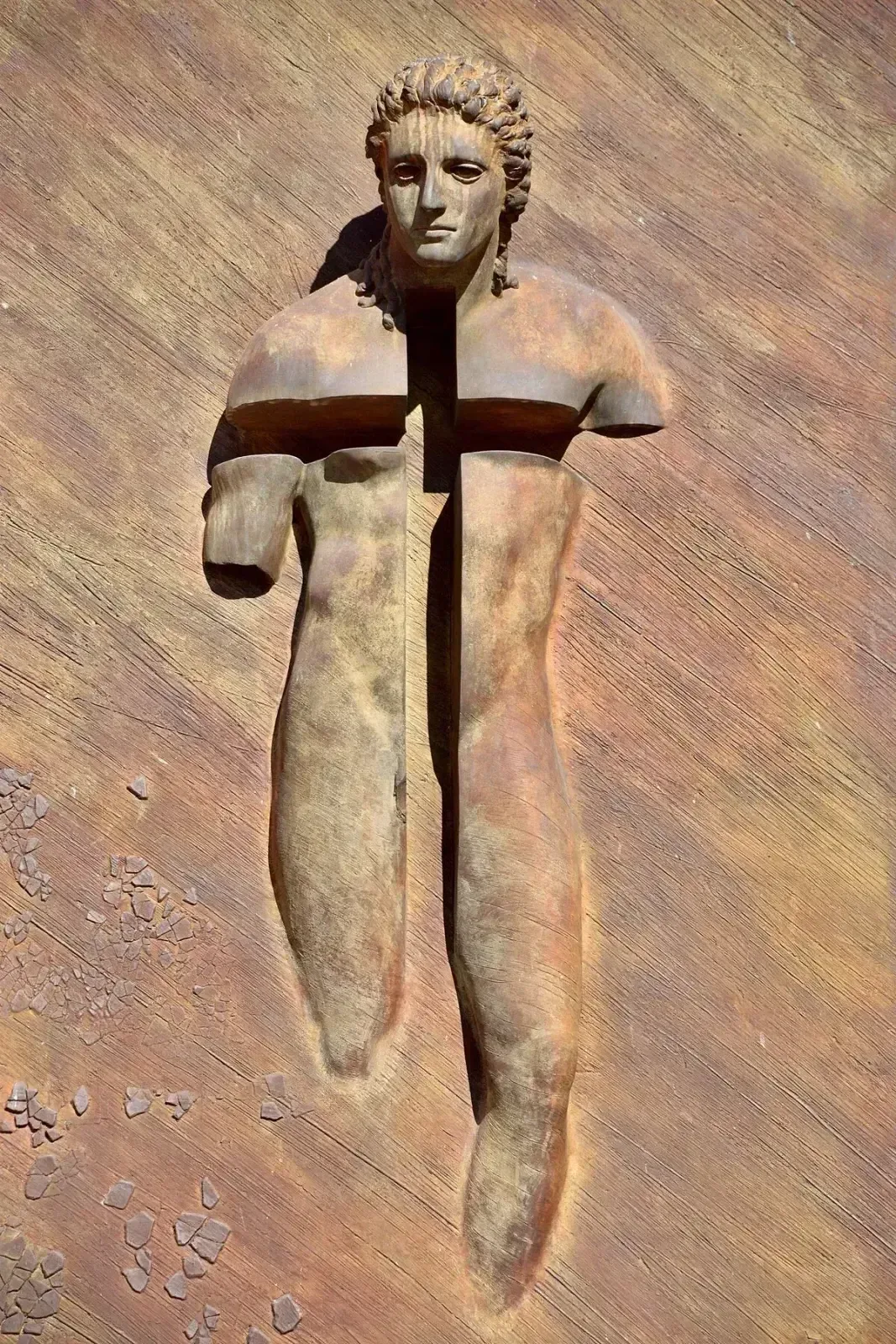
The bronze doors commission came through a process that connected Mitoraj to a long tradition of artist-church collaboration in Rome. Cardinal Francesco Marchisano, then president of the Fabbrica di San Pietro and a significant figure in the Vatican's engagement with contemporary art, was instrumental in advancing the project. The doors weigh approximately six tonnes in total and were cast at the Fonderia Mariani in Pietrasanta, the foundry Mitoraj used for much of his monumental bronze work throughout the 1990s and 2000s. Collectors seeking to understand the scale of Mitoraj's ambition during this period should note that the Santa Maria degli Angeli commission occupied him for several years and coincided with some of his most sought-after limited edition bronzes — works from the early 2000s that now represent a pricing high-water mark at auction. The freestanding San Giovanni Battista installed inside the basilica is distinct from the door reliefs in its full sculptural presence: a fragmented male torso rendered with the combination of classical composure and deliberate incompleteness that defines his mature style, and which serious collectors recognise as the hallmark of his peak output.
The iconographic programme of the Santa Maria degli Angeli commission extended beyond the doors themselves. Mitoraj's freestanding bronze San Giovanni Battista, positioned inside the basilica, depicts the saint in the sculptor's characteristic mode — a fragmented, partially formed figure that reads simultaneously as archaeological find and contemporary vision. The choice of St John the Baptist carried personal resonance: Mitoraj was baptised Catholic in France and maintained a private spiritual dimension to his work that collectors and curators close to him frequently noted, even as his public statements remained measured on the subject. The basilica's unusual history — a Counter-Reformation church embedded within the shell of a third-century imperial bathing complex — mirrors the layered temporal logic that defines Mitoraj's entire output. Visitors approaching from Piazza della Repubblica encounter the doors at eye level, an unusually intimate scale for monumental bronze work of this kind, allowing close inspection of surface detail that rewards the same attention one would bring to a cabinet bronze. For collectors building serious holdings of Mitoraj's work, understanding these Roman commissions is essential context: the iconography, the material dialogue with ancient stone, and the formal language of the public bronzes all recur — at reduced scale — in the edition bronzes and unique works that appear at auction and through specialist dealers. The 2006 unveiling drew considerable institutional attention and consolidated his standing among post-war European figurative sculptors of the first rank.
The doors of Santa Maria degli Angeli e dei Martiri represent one of the few instances where Mitoraj worked directly within an established Catholic liturgical tradition, placing him in a lineage that includes Ghiberti's celebrated doors for the Florence Baptistery and Giacomo Manzù's work for St Peter's Basilica — commissions that, historically, define the reputations of sculptors across generations. The iconographic programme Mitoraj developed for the basilica extends beyond St John the Baptist to incorporate fragmented angelic figures and faces emerging from the bronze surface, consistent with the vocabulary he had developed over decades but here given a specifically sacred charge. Collectors and scholars have noted that the commission arrived at a late and confident period in his career, when his market recognition in Europe was at its height — his solo exhibition at the Boboli Gardens in Florence in 1999 had drawn significant institutional attention and consolidated serious collector interest in his large-format bronzes. The basilica itself draws over a million visitors annually, making Mitoraj's doors among the most-viewed works he ever produced, far exceeding the audience of any gallery or auction context. For collectors assessing his legacy, the Roman commissions carry particular weight: they establish that his work was considered appropriate for the most historically loaded sites in Western European culture, not merely as contemporary ornament but as a continuation of a sculptural conversation stretching back through Bernini, Michelangelo, and the classical world that Mitoraj had always treated as a living inheritance. Works from this period — bronzes dated to the early 2000s — consistently attract the strongest prices when they appear at auction, particularly at Sotheby's and Christie's European sales.
The iconographic choices Mitoraj made for the Santa Maria degli Angeli commission reveal how deliberately he positioned himself within Rome's layered visual history. His fragmentary figures — torsos severed at the shoulder, faces half-consumed by shadow or stone — consciously echo the condition of classical sculpture as it actually survives: damaged, incomplete, recovered from the earth. This was not stylistic mannerism but a considered theological and aesthetic argument: that spiritual meaning persists through, and is perhaps intensified by, incompleteness. For collectors encountering Mitoraj's bronze editions — works such as Tindaro Screpolato, Eros Bendato, or Perseo, all of which exist in numbered casts produced through his Pietrasanta foundry — the Rome commissions provide essential interpretive context. The public works demonstrate at monumental scale what the smaller editions achieve in domestic or gallery settings: a meditation on the fragment as a carrier of memory rather than evidence of loss. Mitoraj's relationship with Rome also informed his auction market profile. Works with documented exhibition histories in Italy — particularly those shown at the 1998 retrospective at the Terme di Diocleziano, held in the very Roman baths whose frigidarium Michelangelo had transformed into the basilica Mitoraj would later furnish — consistently achieve stronger results at auction than comparable casts without Italian provenance threads. Christie's and Sotheby's European sale records from 2010 onward show sustained collector demand for mid-scale bronzes in the 60–100 centimetre range, with Eros Bendato in particular attracting repeat bidding from both European and Middle Eastern collections. For a collector researching acquisition or provenance, understanding that the Roman commissions occupy a distinct register within Mitoraj's broader output clarifies why works with documented Italian exhibition history tend to behave differently at auction from those with purely Northern European provenance trails.
The doors of Santa Maria degli Angeli e dei Martiri represent one of the rare moments in Mitoraj's career when his characteristic formal language — fragmented figures, faces half-dissolved into archaic masks, bodies that suggest ruin and resurrection simultaneously — was applied at truly monumental architectural scale. Each door panel functions as a relief composition in its own right, with the fractured anatomies and veiled profiles that collectors recognise from his smaller bronzes here elevated to a threshold between sacred and civic space. The commission was overseen in close collaboration with the basilica's administration and with the support of cultural patrons who recognised that Mitoraj's Graeco-Roman vocabulary was, for once, not a stylistic choice but a precise historical response to the site. For collectors, the doors provide a useful reference point when assessing his smaller works: the same motifs — the severed wing, the serene closed eye, the male torso arrested mid-dissolution — appear across his limited-edition bronzes and large-scale unique pieces, and understanding the iconographic programme of the Santa Maria doors clarifies the internal consistency of his wider output. The freestanding St John the Baptist installed inside the basilica extends that programme into three dimensions, presenting a figure simultaneously ancient and contemporary, its surface treatment recalling weathered Roman marble while the formal conception is unmistakably twentieth-century. Mitoraj died in Paris in October 2014, and in the years since, institutional and private interest in his work has grown steadily, with major pieces appearing at auction through Sotheby's and Christie's as well as at specialist Italian houses including Wannenes in Genoa. The Rome works have become important anchors for that market narrative: when a collector acquires a bronze head or a winged fragment from the 2000s, the Santa Maria commission establishes the formal and theological context within which that smaller work was conceived, providing an interpretive framework that purely market-oriented documentation cannot supply.
The iconographic programme Mitoraj developed for Santa Maria degli Angeli e dei Martiri extended well beyond the doors themselves. The freestanding bronze of St John the Baptist installed inside the basilica stands approximately three metres tall and exemplifies the sculptor's mature handling of fragmentation — the figure's surface bearing deliberate lacunae, as though the bronze had partially surrendered to the same erosion that consumed the ancient marble it references. Cardinal Virgilio Noè, then Archpriest of St Peter's Basilica and a significant advocate for contemporary sacred art within the Vatican's sphere, was among those who supported the commission, which placed Mitoraj in a lineage of artists asked to reconcile modern sculptural language with Counter-Reformation architecture. The basilica's unusual spatial history — Michelangelo's 1563 conversion preserved the vast concrete vaulting of Diocletian's third-century frigidarium, making it one of the few places in Rome where ancient Roman engineering is directly inhabited as Christian space — resonated profoundly with Mitoraj's longstanding preoccupation with layered time. His Pietrasanta studio maintained plaster working models for both the doors and the Baptist figure, and several preparatory bronze casts in reduced scale circulated privately during the years following the 2006 unveiling; at least two are known to have passed through the Italian secondary market. For collectors, works from this period — roughly 2002 to 2008 — represent Mitoraj at his most resolved: the compositional ambition of the large public commissions fed directly into the numbered edition bronzes produced concurrently, and the thematic coherence between, say, a cabinet-scale Testa di San Giovanni and the monumental Baptist inside the basilica gives those smaller works an unusually leg
The iconographic programme Mitoraj developed for Santa Maria degli Angeli e dei Martiri extended well beyond the doors themselves, making this the most layered expression of his mature theological and aesthetic thinking. The freestanding San Giovanni Battista installed inside the basilica presents the Baptist as a fragmented, monumental torso — the body incomplete in the way Mitoraj consistently treated the human form, as though heroic potential and mortal ruin existed simultaneously within a single figure. This treatment aligned deliberately with the basilica's own layered identity: Michelangelo had embedded a Christian church within the ruins of imperial Rome, preserving the ancient vaulting and brick as the nave's bones, and Mitoraj's additions continued that conversation across fifteen centuries of accumulated meaning. The commission was overseen in part by Cardinal Camillo Ruini, then Vicar General of Rome, and the unveiling drew significant institutional attention precisely because it placed a living artist's hand on one of the city's most symbolically resonant thresholds. For collectors and scholars tracking Mitoraj's market, the Santa Maria degli Angeli commission operates as a kind of benchmark: works produced in the years immediately surrounding major public commissions — roughly 2003 to 2008 for this period — tend to carry additional provenance interest because studio documentation from those phases is often more complete, with correspondence, maquettes, and foundry records surviving in greater quantity than for earlier decades. Mitoraj worked primarily with the Fonderia Artistica Battaglia in Milan, one of Italy's most respected bronze foundries, for his large-scale castings, and works bearing Battaglia stamps from this period are considered particularly well-attested in terms of casting quality and edition integrity. The Rome permanent works also function as orientation points for understanding the full range of Mitoraj's mature production, since the iconographic and material decisions visible at the basilica recur, in adjusted form, across the editioned bronzes that constitute the bulk of works available to private collectors.
The iconographic program Mitoraj developed for Santa Maria degli Angeli e dei Martiri extended well beyond the doors themselves. The freestanding San Giovanni Battista installed inside the basilica stands approximately three metres tall and presents the Baptist as Mitoraj characteristically rendered his subjects — not in narrative action, but in a state of arrested presence, the figure fragmented yet monumental, the surface carrying the controlled roughness that became a signature of his mature bronze work. The commission was overseen in part through his longstanding relationship with the Fondazione Roma, and the unveiling in April 2006 was attended by senior figures of the Vatican as well as Rome's civic administration, reflecting the degree to which the project was understood as a civic and religious event rather than simply an art installation. For collectors and scholars, the Santa Maria degli Angeli commission is particularly significant because it represents one of the few moments in Mitoraj's career where his personal mythological vocabulary — drawn from Greek and Roman antiquity — was formally reconciled with Christian iconography under institutional patronage. Mitoraj had navigated this tension privately throughout his life: born in Oederan in 1944 to a French father and Polish mother, he converted to Catholicism as an adult, and his faith quietly inflected works that might otherwise read as purely secular engagements with classical form. The bronze doors carry this duality explicitly: the panels depicting scenes from the life of St John the Baptist are rendered with the same formal grammar Mitoraj applied to figures from Ovid or Homer — faces partially veiled, bodies incomplete, time written into the material itself. Pietrasanta, where Mitoraj maintained his primary studio from the 1980s until his death in September 2014, operated as the production centre for works of this scale; the foundry relationships established there with the Fonderia Mariani and, for the largest commissions, with the Fonderia Artistica Battaglia in Milan, account for the technical consistency that distinguishes authenticated late-period bronzes from less rigorously documented later production.
The commission process for the Santa Maria degli Angeli doors unfolded over several years and involved the direct endorsement of Pope John Paul II, who expressed personal support for Mitoraj's involvement before his death in 2005 — lending the project a theological as well as artistic gravity that was not lost on the sculptor. Mitoraj, who had converted to Catholicism, approached the subject of St John the Baptist not as a purely formal exercise but as an expression of spiritual belief, and this distinguishes the Rome commission from his many secular public works in Pompeii, Paris, and elsewhere. The bronze doors themselves stand approximately nine metres tall and are divided into panels whose fractured, archaeological quality — faces half-emerged, limbs incomplete — deliberately echoes the condition of classical antiquity as it survives today: broken, partial, yet radiating persistent authority. This formal strategy, which Mitoraj had been developing since the late 1970s following his pivotal 1979 exhibition at the Galerie La Hune in Paris, here reaches a kind of institutional culmination: a contemporary sculptor using the visual language of ruin to create new sacred imagery for one of Rome's most visited churches. Collectors and scholars of Mitoraj's work frequently point to the Santa Maria degli Angeli commission as the moment his reputation moved decisively beyond the gallery circuit into the realm of major civic and ecclesiastical patronage — a trajectory that in turn affected the secondary market for his bronzes, with documented auction results for comparable large-format works increasing substantially through the late 2000s and into the 2010s. His studio in Pietrasanta, maintained until his death in September 2014, produced both the monumental editions associated with public commissions and smaller, more intimate casts — heads, torsos, winged fragments — that circulated through European galleries and now appear with reliable regularity at the major international salesrooms, providing collectors with the principal point of entry to Mitoraj's mature work.
The decision to commission Mitoraj for Santa Maria degli Angeli e dei Martiri was not made in isolation — it reflected a broader institutional confidence in his ability to create work that could hold its own within the most historically saturated environments in Western art. By the mid-1990s, Mitoraj had already demonstrated this capacity with major commissions in Pompeii, where fragments of his bronze figures were placed among the ancient ruins in 1998 in what became one of his most discussed site-specific projects, and at the Acropolis in Athens, where Eros Bendato was exhibited in 2003. Rome, however, represented a different order of ambition. The doors of Santa Maria degli Angeli e dei Martiri are among the largest works Mitoraj ever executed in bronze, and the commission required years of preparation at his Pietrasanta foundry, where he collaborated with skilled bronze casters who had worked alongside him for much of his Italian career. The iconographic programme of the doors draws on both Christian and classical sources simultaneously — a characteristic Mitoraj gesture that refuses to treat these traditions as separate — and the St John the Baptist figure installed within the basilica interior extends this reading into three dimensions, allowing visitors to move around a work that functions both as devotional object and as sculpture in the modernist sense. Collectors who encountered Mitoraj's work through gallery exhibitions in Paris, where he showed with Galerie Enrico Navarra from the 1980s, or through auction appearances at Christie's and Sotheby's, often found that seeing the Roman commissions changed their understanding of the smaller bronzes and marbles in their own collections — the fragmented torsos and veiled heads that had seemed formally self-contained revealed themselves as part of a sustained meditation on Roman and Greek antiquity that could only be fully grasped when individual works were considered against the architectural scale of the Roman commissions.
The commission process for the Santa Maria degli Angeli doors unfolded over several years and involved the direct patronage of the Diocese of Rome under Cardinal Camillo Ruini, reflecting the institutional confidence that Mitoraj had earned by the early 2000s through major public projects across Europe and the United States. The doors themselves — weighing several tonnes and cast in sections at the Fonderia Mariani in Pietrasanta, the foundry with which Mitoraj maintained a close working relationship throughout the latter part of his career — represent a summation of the figurative concerns he had pursued since the late 1970s: the fragmented body as a vessel of spiritual meaning rather than physical defeat. The imagery draws on early Christian iconography refracted through Mitoraj's distinctively archaeological sensibility, with faces emerging from geometric forms and limbs interrupted at the point where bronze meets negative space. Scholars and critics who have written on late-twentieth-century sacred art in Italy — among them the art historian Mariastella Margozzi, who curated significant retrospective material on Mitoraj in the Italian context — have noted that the doors occupy an unusual position in post-conciliar church art: neither conventionally devotional nor self-consciously avant-garde, but genuinely mediating between liturgical function and contemporary sculptural language. For collectors, this institutional dimension matters. Works that entered the market from the same productive period as the Santa Maria degli Angeli commission — roughly 2000 to 2008 — carry a documentary context that links them to the peak of Mitoraj's public recognition and to a body of work that is now permanently installed in some of the most visited sites in Europe, including the Valley of the Temples at Agrigento, where his 2011 exhibition left several pieces as a lasting loan. The freestanding
The bronze doors of Santa Maria degli Angeli e dei Martiri represent one of the rare instances where Mitoraj worked at architectural scale on a functioning liturgical commission, and understanding their place within his broader output helps collectors contextualise the works they encounter at auction or in gallery settings. Mitoraj had earlier demonstrated his capacity for monumental religious work with the doors of the Cathedral of Częstochowa in Poland, unveiled in 2001, but the Roman commission demanded a different register entirely — less the charged nationalism of a Polish pilgrimage site, more the layered, secular-sacred ambiguity that characterises Roman public space. The doors at Santa Maria degli Angeli are composed in several registers, with fragmented figures emerging from and dissolving back into the bronze surface, a technique Mitoraj had refined across decades of smaller foundry work at the Bocchia foundry in Pietrasanta and later in collaboration with the Tescari foundry. For collectors accustomed to his smaller bronzes — the busts, the winged torsos, the severed heads with their closed or averted eyes — the doors reveal how consistently he applied the same formal vocabulary regardless of scale: the interrupted silhouette, the suggestion of archaeological recovery, the face half-present and half-consumed by the material itself. This consistency is precisely what gives the secondary market for his work its relative stability. Mitoraj bronzes in the twenty to sixty centimetre range, particularly signed and numbered casts from limited editions produced between the mid-1980s and his death in Pietrasanta in October 2014, have held and in several cases appreciated in value at European auction houses including Artcurial in Paris and Dorotheum in Vienna, where his works appear with reliable regularity. The Tindaro series — the large cr acked heads in which fissured surfaces open onto an interior void — has remained among the most consistently bid categories within his market, with documented exhibition history reliably supporting the upper end of pre-sale estimates.
The collector market for Mitoraj's Roman-themed works reflects a consistent hierarchy that has held steady since the late 1990s: bronzes conceived explicitly in dialogue with classical Roman iconography — winged heads, fragmentary torsos of emperors, veiled faces in the manner of ancient funerary sculpture — command measurably higher premiums at auction than works from other periods or thematic groups. This is partly a function of provenance and partly of cultural legibility. A European or American collector acquiring a Mitoraj bronze knows, without specialist knowledge, exactly what tradition is being invoked. Christie's Paris sale of May 2019 saw Tindaro Screpolato, one of Mitoraj's signature cracked-helmet heads, achieve €187,500 — well above its high estimate — while contemporaneous works from his later Pietrasanta period with looser mythological references performed more modestly. The Roman works carry weight because the references are unambiguous: the Baths of Diocletian, the Pantheon's coffered ceiling, the fractured marble of the Capitoline Museums. Mitoraj spent considerable time in Rome itself during the planning phase of the Santa Maria degli Angeli commission, making studies in the city rather than working solely from his Pietrasanta studio, and this directness of engagement is legible in the finished bronze doors in a way that distinguishes them from edition works produced for the gallery market. For collectors interested in works that occupy the intersection of the ancient and the contemporary, it is also worth knowing that Mitoraj made a number of smaller bronze studies — maquettes and preparatory pieces — related to his Roman public commissions, and that a small number of these entered private hands through his primary Italian dealers, most notably the Galleria d'Arte Niccoli in Par ma, where catalogue records from the 2000s remain a useful reference for collectors attempting to trace the early circulation of works directly related to the Roman commissions.
The iconographic program Mitoraj developed for Santa Maria degli Angeli e dei Martiri extended well beyond the doors themselves, forming a cohesive ensemble that rewards sustained looking. The freestanding bronze of San Giovanni Battista — positioned within the basilica's interior — depicts the saint in Mitoraj's characteristic idiom: the figure incomplete, the surface bearing the evidence of time and rupture, yet projecting an unmistakable spiritual presence through its very fragmentation. This approach was not arbitrary aesthetics but a considered theological argument: that the sacred persists through and within damage, that faith survives catastrophe. The commission was overseen with the direct support of Cardinal Virgilio Noè, then Archpriest of the Vatican Basilicas, whose advocacy for contemporary art within historic sacred spaces gave Mitoraj the institutional confidence to work at this scale without compromise. The basilica's own history made this resonance structural rather than metaphorical — the building that Michelangelo converted from the frigidarium of Diocletian's baths already embodied the transformation of pagan Roman architecture into Christian sacred space, precisely the kind of layered temporal collapse that animated Mitoraj's entire practice. Collectors and scholars who visit the site specifically to study the doors frequently note that the left and right panels reward close attention to their respective registers: the upper zones carry monumental figures of serene, archaic weight, while the lower registers introduce greater fragmentation and tension, a compositional grammar that Mitoraj had refined across major commissions in Agrigento, Lausanne, and Pietrasanta over the preceding two decades. The Agrigento commission — the celebrated installation among the temples of the Valle dei Templi, where works including Ikaro and Tind aro Screpolato were placed against the standing Doric architecture of fifth-century BC Sicilian Greece — provides one of the most direct visual precedents for the formal logic eventually applied at Santa Maria degli Angeli.
The relationship between Mitoraj's Roman commissions and the broader secondary market for his work is worth understanding for serious collectors. His large-scale bronzes — the monumental typology to which the Santa Maria degli Angeli doors belong — were almost exclusively produced for public or institutional clients, and none have appeared at auction in anything approaching comparable scale. What does circulate is a distinct category of work: the mid-sized bronzes and the patinated bronze heads, torsos, and winged figures produced in limited editions through Mitoraj's studio in Pietrasanta, often in editions of six to nine casts, sometimes with an artist's proof. These were the works sold through his principal gallery relationships, most consistently with Galerie Trigano in Paris and, for the Italian market, through dealers operating out of Milan and Florence. Auction records from Christie's, Sotheby's, and Bonhams between 2010 and 2023 show that demand for Mitoraj's mid-scale bronzes remained remarkably stable even after his death in Pietrasanta in September 2014, with hammer prices for authenticated works in the 60–100 cm range typically settling between £40,000 and £120,000 depending on subject, patination, and provenance clarity. Works with documented exhibition history — particularly those shown at the Pompeii installation of 2016, which was organised posthumously and drew extraordinary international attention — command a measurable premium, partly because the Pompeii context reinforced so precisely the intellectual argument that had always underpinned Mitoraj's practice: that the fragmented classical body was not a ruin but a living form suspended between worlds. Tindaro Screpolato, one of his most recognised subjects — a cracked bronze head revealing a luminous interior — exists in multiple scaled editions cast at the Pietrasanta foundries, with the smaller variants appearing at auction with sufficient frequency to provide a reasonably stable pricing reference for serious buyers.
Have questions about this work?
Ask the AI assistant — grounded in this collection's pages, replies in your language.
The travertine material Mitoraj selected for both Roman commissions carries profound significance beyond mere aesthetics—it represents a deliberate curatorial choice that anchors his work within Rome's geological and historical narrative. Travertine, quarried primarily from Tivoli and the surrounding Lazio region, has been extracted continuously since Roman times, making it not simply a stone but a temporal thread connecting ancient construction practices to contemporary practice. Mitoraj's use of this material for Dea Roma and the Santa Maria degli Angeli project reflects his sophisticated understanding of how materials themselves function as historical documents. The stone's porous surface and warm honey-to-cream coloring weather distinctively in Rome's climate, developing a patina that integrates the sculptures into the urban fabric rather than presenting them as foreign insertions. For collectors acquiring Mitoraj's Roman-period works or those interested in his Italian production, this material choice signals his late-career engagement with site-specificity and archaeological consciousness—a departure from his earlier bronze practice that dominated his international career. The Piazza Monte Grappa location, situated in the Esquilino district near the major transport hub of Termini Station, means Dea Roma reaches a vastly larger public audience than many contemporary public sculptures, visited daily by commuters, tourists, and residents navigating one of Rome's busiest intersections. This placement also positions the work within a complex urban renewal narrative; the piazza itself was redesigned in the 1980s-1990s as part of broader efforts to revitalize the Esquilino area, making Mitoraj's 2003 installation part of a larger conversation about Rome's relationship with modernization and contemporary artistic intervention in historic space. The gift from Finmeccanica—Italy's major defense and aerospace con
Own a Mitoraj Work?
I buy Mitoraj bronzes, marbles, lithographs and drawings directly and privately — anywhere in Europe. Discreet, prompt, fair price.
Any other Mitoraj work also welcome — any subject, condition, or format.
See also: Pietrasanta — Mitoraj's studio city · All bronzes wanted · All cities worldwide · Interactive Europe map
Mitoraj in Rome — Sacred Commissions
Rome is home to one of Mitoraj's most significant permanent commissions: the monumental bronze doors of the Basilica of Santa Maria degli Angeli e dei Martiri, installed in 2006. Designed by Michelangelo in the ruins of the Baths of Diocletian, the basilica is one of Rome's most spiritually charged spaces, and the commission — depicting scenes of Christian martyrdom rendered in Mitoraj's characteristic fragmented vocabulary — was widely regarded as the culmination of his dialogue with antiquity. The doors are a pilgrimage site for Mitoraj enthusiasts visiting Rome and a frequently cited reference point in auction catalogue scholarship on the artist.
Interested in this work?
Inquire about this work →Thinking of selling a Mitoraj? See our dedicated sell page →