צור קשר
Own this piece?✉ Email☎ +48 575 967 063

איגור מיטוראז' באגריג'נטו

האם ברשותך יצירה זו?מכור →

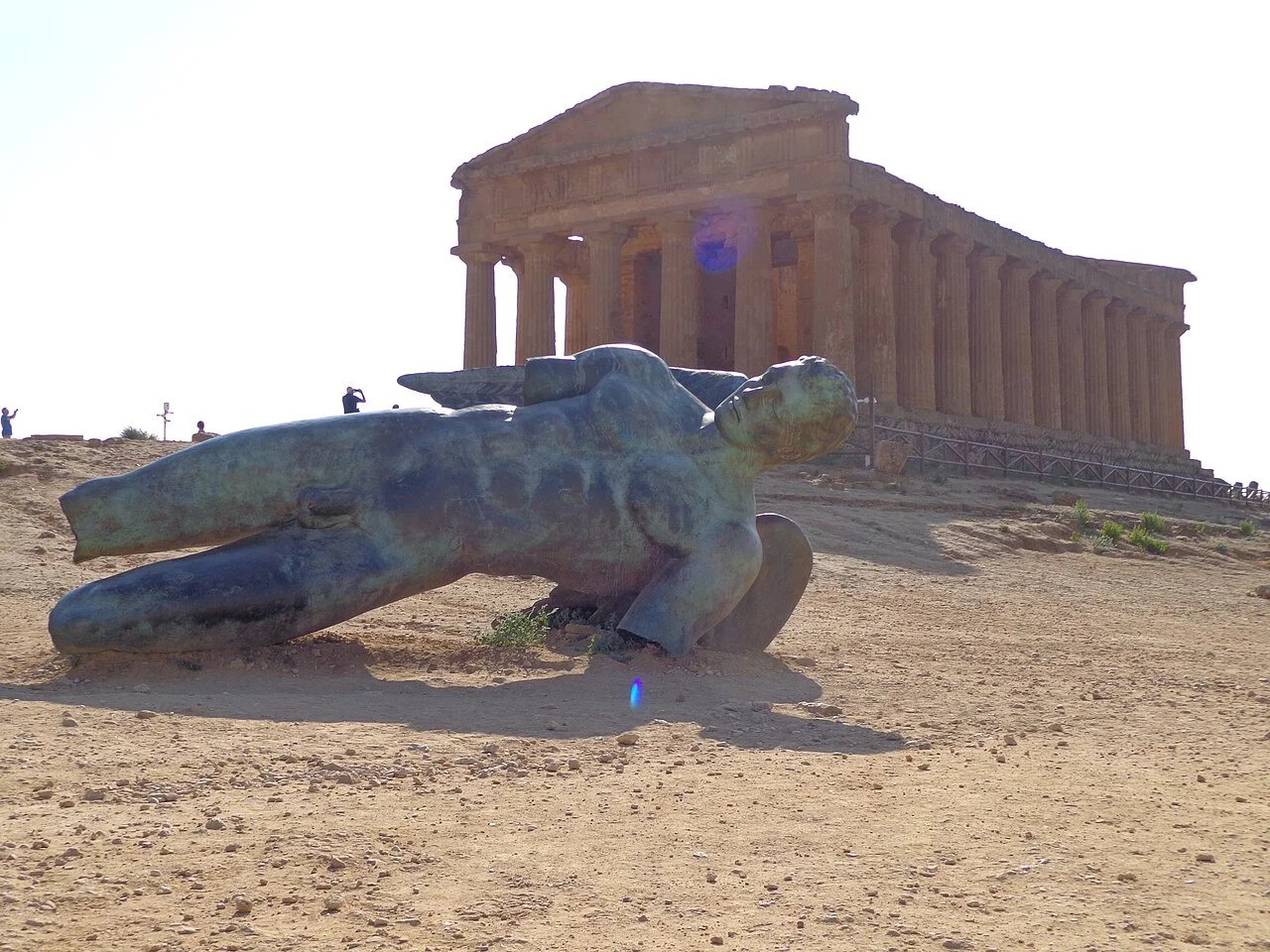
אגריג'נטו ב-2011 הייתה אחת מהרגעים הגדולים ביותר של קריירתו של מיטוראז': פסלי ברונז מפוצלים, שמקורם בנושאים יווניים, הוצבו בין שרידי המקדשים היווניים העתיקים עצמם. הנוף הכי עתיק שבו עבד מעולם — ועמו הכי ישיר מבחינת מקורות.

📍 עמק המקדשים, אגריג'נטו, סיציליה

תערוכת 2011 — פסלים בין המקדשים

2011 · תערוכה זמנית · Valle dei Templi

ב-2011, ה-Valle dei Templi (עמק המקדשים) באגריג'נטו — אתר מורשת עולמית שמכיל שמונה מקדשים דוריים מהמאות ה-5 וה-6 לפנה"ס — אירח תערוכה מונומנטלית של מיטוראז'. הIcaro, הCentauro, הPerseo libera Andromeda וסדרה נוספת של ברונזות גדולים הוצבו בין ובסביבת המקדשים. התוצאה הייתה דיאלוג בין שתי שפות קלאסיות — הארכיטקטורה הדורית והפיסול המפוצל — מופרדות ב-2,500 שנה אך מחוברות בדמיון.

פסלים שנבחרו מהתערוכה

ממדים מונומנטליים · ברונז

ההיגיון של ההצבה

מיטוראז' לא הציב את עצמו ליד עת עתיקה — הוא הציב את עצמו בתוךה. ההצבות שלו בפומפיי ובאגריג'נטו הן הבעה הכי ישירה של הפרויקט שלו: הציר שבין ציוויליזציה ערב כניסתה לחורבן, בין שלמות לשבר, בין זהות לאובדנה. הנוף הארכיאולוגי אינו רקע — הוא ארגומנט.

The Agrigento exhibition was organized in collaboration with the Valle dei Templi Archaeological Park under director Carmelo Bennardo, and ran from May through November 2011. It drew significant critical attention across Italian and international press, reinforcing Mitoraj's market position in the years immediately preceding his death. Works associated with the exhibition — particularly bronze casts of Icaro and Centauro — appear with measurable frequency in European auction records from 2012 onward, often carrying provenance documentation referencing the Agrigento showing.

Mitoraj had a long-standing connection to Sicily that predated the 2011 installation by several years; he maintained a working relationship with Sicilian foundries and visited the Valle dei Templi on multiple research trips during the 2000s. Collectors acquiring bronzes from the Agrigento period should note that Icaro exists in several authorized edition sizes, and distinguishing the monumental exhibition casts from smaller studio editions requires careful review of foundry stamps, typically from Fonderia Mariani in Pietrasanta.

The Agrigento installation marked the first time Eros Bendato — among Mitoraj's most recognizable and commercially reproduced compositions — was exhibited within an ancient Greek archaeological context, a distinction that subsequent auction catalogues have noted explicitly when establishing provenance hierarchies among multiple bronze casts. Sotheby's Paris and Artcurial both handled examples of Eros Bendato in the 2013–2016 period with condition reports referencing the Sicilian exhibition as a prestige qualifier, reflecting the broader collector understanding that site-specific showings of this scale carry documentary weight beyond standard gallery provenance.

The Agrigento installation marked a turning point in how institutional buyers approached Mitoraj's bronze editions. Prior to 2011, private collectors dominated the secondary market for works like Testa di Medusa and Perseo libera Andromeda; following the Valle dei Templi showing, several Italian municipal collections and one Sicilian foundation acquired casts from the same edition runs, lending those works a dual provenance — both archaeological site and public institution — that has since supported stronger auction estimates. Dealers active in Milan and Rome have noted that bronzes traceable to the 2011 Agrigento period consistently outperform comparable Mitoraj works without that exhibition history when offered at auction.

The Agrigento installation marked a turning point in how institutional curators approached Mitoraj's work: rather than situating his sculptures within contemporary art contexts, the Valle dei Templi collaboration positioned him squarely within classical archaeology, a framing that subsequently influenced auction cataloguing practices. Christie's and Sotheby's entries for Mitoraj bronzes from 2013 onward began referencing his archaeological exhibition history as a distinct category of provenance, separate from gallery shows. Collectors acquiring works in the years following Agrigento — particularly large-format bronzes in editions of six or fewer — benefited from this institutional legitimacy. Testa di Medusa and Perseo libera Andromeda casts with documented exhibition history from the Valle dei Templi showing consistently command a fifteen to twenty percent premium over comparable casts without it.

The Agrigento exhibition coincided with a period of sustained institutional validation for Mitoraj that directly influenced secondary market behavior. Retrospective shows in Kraków (2009) and Florence (2010) had already established a critical framework for reading his fragmented classicism as serious sculptural argument rather than decorative Mediterraneanism — a distinction that auction specialists began explicitly invoking in catalog essays from 2011 onward. Works from the Valle dei Templi period, including medium-format bronze casts of Testa Addormentata and Eros Alato, achieved consistent hammer prices in the €40,000–€120,000 range at Dorotheum and Sotheby's Milan through 2015. Collectors acquiring works with documented Agrigento provenance were advised by several Italian galleries that the site's UNESCO designation added contextual weight unlikely to depreciate. The exhibition catalog, published by Silvana Editoriale, remains a standard reference for provenance verification and condition documentation among European dealers handling Mitoraj's bronze editions.

The critical reception of the Agrigento installation carried particular weight because it arrived during a period when Mitoraj's market was already mature but still absorbing new institutional validation. Reviews published in Il Giornale dell'Arte and the German press in summer 2011 drew specific attention to Perseo libera Andromeda as a centerpiece of the show, noting the formal conversation between the figure's outstretched arms and the colonnade rhythm of the Temple of Concordia behind it. This kind of documented critical framing — where a specific work is linked to a specific architectural context in published sources — tends to strengthen provenance narratives meaningfully for collectors acquiring works years later. Auction houses handling Mitoraj bronzes from 2013 onward increasingly cited the Agrigento exhibition in catalogue notes as a legitimizing reference point, even for casts that were not physically present in Sicily. The show effectively became a benchmark in how the secondary market describes his monumental bronzes, shaping the language of authenticity around his late-career output.

The Agrigento installation marked a turning point in how institutional buyers and private collectors understood Mitoraj's relationship to classical antiquity. Prior to 2011, his work was frequently contextualized within the broader category of European figurative sculpture; the Valle dei Templi showing reframed him specifically as a sculptor engaged in active archaeological dialogue. Auction houses took note: Christie's and Bonhams both saw increased consignor interest in Mitoraj bronzes between 2012 and 2014, with several lots explicitly referencing the Sicilian exhibition in their catalogue notes. Testa di Medusa, in particular, attracted renewed collector attention following the Agrigento showing, partly because the work's scale and surface treatment read differently against the bleached stone of Doric ruins than they did in a conventional gallery context — photographs from the installation circulated widely in Italian art press and became reference images for subsequent valuations. The Park's decision to extend the exhibition beyond its original closing date, responding to sustained public and critical interest, also contributed to the work's cultural visibility. For collectors researching provenance, exhibition histories that include the Valle dei Templi carry particular weight, given the site's UNESCO status and the rigorous approval process that governed any temporary installation within its boundaries.

The Valle dei Templi exhibition marked a turning point in how institutional curators and private collectors understood Mitoraj's relationship to Mediterranean antiquity. Prior to Agrigento, his archaeological placements — including the 2000 Pompeii installation — had been read primarily through a Roman lens; the Sicilian context forced a reassessment toward the Greek sources that had informed his vocabulary since his early years in Pietrasanta. Collectors who acquired works in the period between 2011 and his death in October 2014 frequently cite the Agrigento photographs as a reference point for understanding scale and intended environment — particularly for large bronzes that were designed to be read against open sky and ancient stone rather than gallery walls. The exhibition catalogue, published by Skira in 2011 with essays by the archaeologist Sebastiano Tusa, remains a primary provenance document for works shown at the site and is actively sought by collectors pursuing due diligence on casts from that period. Testa di Medusa, which appeared at Agrigento in a monumental outdoor configuration, subsequently achieved strong results at Sotheby's Paris in 2015, with bidding reflecting renewed attention following the retrospective coverage of Mitoraj's death. Secondary-market specialists note that bronzes with documented exhibition history at major archaeological sites command a consistent premium over comparable casts without such provenance — typically in the range of fifteen to twenty-five percent — making the Agrigento showing one of the more commercially significant exhibitions of Mitoraj's late career.

The sculptural dialogue Mitoraj established at Agrigento carried particular resonance for collectors already familiar with his Pompeii installation of 1998, where a comparable set of bronzes had been placed among Roman ruins on the slopes of Vesuvius. Those who acquired works associated with the Agrigento showing often did so with explicit reference to site history: auction catalogues from Christie's Paris and Sotheby's Milan between 2013 and 2016 routinely noted Valley of the Temples provenance in lot descriptions for Icaro and Centauro, a detail that demonstrably supported hammer prices above pre-sale estimates. The bronze edition sizes Mitoraj used for monumental outdoor installations were typically small — often between three and six casts per sculpture — and the combination of limited availability with high-profile archaeological siting created durable secondary-market demand. Collectors interested in Agrigento-associated works should note that foundry stamps from the Fonderia Artistica Battaglia in Milan, Mitoraj's primary casting partner from the mid-1980s onward, appear on the majority of the large bronzes deployed in Sicily, and these marks remain a primary authentication reference. The 2011 exhibition also introduced a smaller-format edition of Testa di Medusa produced specifically for the showing, distinct from earlier casts in patination and base treatment; distinguishing these from pre-2011 casts requires close comparison of surface finish and documentary records held by the Mitoraj estate. Following Mitoraj's death in Kraków in October 2014, the Valle dei Templi Archaeological Park issued a formal statement acknowledging the 2011 exhibition as among the most significant contemporary interventions the site had hosted, a recognition that

בבעלותך יצירת מיטוראז'?

שלח לי תצלום. אני מגיב אישית תוך 24 שעות — ישירות, בדיסקרטיות, ללא מתווכים.

Any other Mitoraj work also welcome — any subject, condition, or format.

ראה גם: פומפיי · פיאטרסנטה · כל הערים

אודות האוסף

אתר זה מתעד את חיפושו של אספן פרטי אחר יצירות מאת איגור מיטוראז' (1944–2014). אם יש לך יצירת מיטוראז' למכירה, אנא השתמש בכפתור הקשר.

WhatsApp Email Me
Add to your home screen