דלג לתוכן
צור קשר
Own this piece?✉ Email☎ +48 575 967 063

איגור מיטוראז' בלונדון

האם ברשותך יצירה זו?מכור →

לונדון מאכלסת שלושה ברונזות קבועים של מיטוראז' — כולם בקנרי וורף, רובע הפיננסים במזרח לונדון. האוסף נמשך משנת 1983 עד שנות ה-2000 וכולל אחד מהיצירות המונומנטליות הראשונות של מיטוראז', יציקת Centurione I ו-Eros Bendato. יחד הם מהווים את הנוכחות הציבורית המשמעותית ביותר של מיטוראז' בבריטניה.

📍 קנרי וורף, לונדון E14

Testa Addormentata (הראש הישן) — 1983

ברונז · קבוע · קנרי וורף · מהיצירות המונומנטליות הראשונות של מיטוראז'

Testa Addormentata — הראש הישן — היא מבין הראשונות מבין יצירות הברונז המונומנטליות הקבועות של מיטוראז'. נוצקה ב-1983, מספר שנים לאחר שמיטוראז' התחייב לעבודת פיסול בפיאטרסנטה, היא מציגה גישה קלאסית ישירה יותר לנושא הראש המפוצל. העיניים עצומות, תחושה של הכרה הנסוגה מהעולם, גודל מונומנטלי המוחל על משהו אינטימי ופנימי.

פיתוח קנרי וורף עשה מחויבות מכוונת לאמנות ציבורית כחלק מזהותו. ה-Testa Addormentata נרכשה כחלק מתוכנית זו, ומביאה את יצירתו של מיטוראז' במגע יומיומי עם עשרות אלפי עובדים ומבקרים.

📍 קנרי וורף, לונדון E14

Centurione I — קבוע

ברונז · קנרי וורף · קבוע · מהדורה 1987, 250 עותקים

Centurione I בקנרי וורף הוא יציקה מונומנטלית של הסדרה שהפכה לנושא המוכר ביותר של מיטוראז' ברחבי העולם. נוצר לראשונה ב-1987 במהדורה של 250 (בקנה מידה שולחני), הנושא של Centurione I נוצק לאחר מכן בפורמטים גדולים יותר לאוספים ציבוריים.

ה-Centurione — פניו של חייל רומי, עם קסדה, מפוצל, עם עיניים נעדרות — מהדהד במיוחד עם ההקשר האדריכלי הארגוני של קנרי וורף. שבר הסמכות העתיקה שמוצב בין מגדלי הזכוכית של הפיננסים המודרני יוצר טיעון ויזואלי על רציפות הכוח, גבולותיו ועלויותיו.

📍 קנרי וורף, לונדון E14

Eros Bendato (ארוס הכבול) — קבוע

ברונז · קנרי וורף · קבוע

Eros Bendato — ארוס הכבול — הוא אחד מהנושאים המפורסמים ביותר של מיטוראז': פניו של אל האהבה, עיניו חבושות, כבול ועיוור. הנושא מופיע לאורך כל קריירתו בקנה מידה ומהדורות מרובים, מהמיצב המונומנטלי בקראקוב ועד למהדורות אספנים קטנות יותר.

חבישת ארוס — כבילת האהבה, התשוקה, החושים — היא אחת מהמחוות הסמליות הבולטות ביותר של מיטוראז'. בהקשר של רובע פיננסי, דמות ארוס המסונוור מקבלת אירוניה ספציפית שהאמן כמעט בוודאי התכוון אליה.

אוסף מיטוראז' של קנרי וורף בהקשרו

שלוש היצירות של מיטוראז' בקנרי וורף מהוות את האוסף הציבורי המרוכז ביותר של ברונזותיו בבריטניה. הן נרכשו בשלבים שונים של פיתוח קנרי וורף. קבוצת קנרי וורף, המנהלת את האחוזה, שמרה על מחויבות עקבית לפיסול בינלאומי מרכזי.

שוק אספני מיטוראז' בבריטניה

קונים בריטים היו מבין הפעילים ביותר באופן עקבי בשוק המשני הבינלאומי של מיטוראז'. Christie's, Sotheby's ו-Bonhams בלונדון השיגו תוצאות חזקות עבור ברונזות Centurione, Persée ו-Eros Bendato.

אם אתה מבוסס בבריטניה ובבעלותך יצירת מיטוראז' — ברונז, שיש, ליתוגרף או ציור — אני קונה ישירות ובאופן פרטי. אני מגיב לכל פנייה אישית תוך 24 שעות ומטפל בכל העסקאות בשיקול דעת מלא.
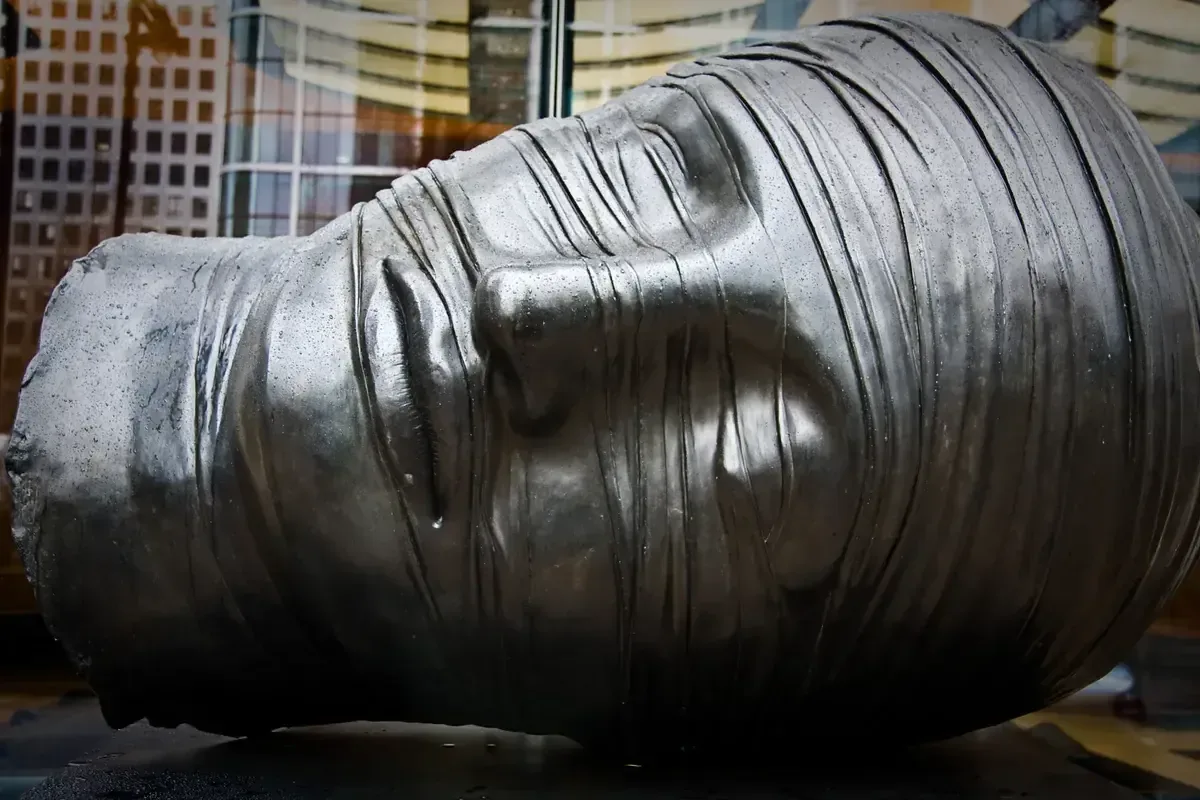
פסל ברונז Testa Addormentata של איגור מיטוראז' 1983, קנרי וורף, לונדון
Testa Addormentata (1983) בקנרי וורף. תצלום: Garry Knight, CC BY-SA 2.0

Mitoraj's relationship with British collectors deepened significantly during the 1990s, when several London-based galleries began representing his work alongside Italian and French dealers. The Halcyon Gallery, operating from its Bond Street premises, introduced his smaller bronzes to a new tier of private buyers who might not encounter the Canary Wharf installations directly. Editions of Eros Bendato and Testa di Guerriero circulated through this network, establishing secondary market prices that have since risen considerably. Auction records at Sotheby's and Christie's London show consistent demand from the late 1990s onward, with monumental-scale works commanding premiums over the standard numbered editions. For collectors, provenance from early British acquisitions — particularly pre-2000 purchases — carries additional documentary value.

Mitoraj's relationship with the British market developed steadily through the 1980s and 1990s, with several London galleries serving as early intermediaries between his Pietrasanta studio and UK collectors. The Canary Wharf acquisitions reflect a broader pattern: major corporate and civic collections in Europe — including installations in Paris, Rome, and Munich — were assembled during this same period, as institutional buyers recognised that Mitoraj's edition structures offered both aesthetic coherence and defensible provenance. For private collectors, works from the 1980s bronze editions carry particular weight precisely because they predate the artist's widespread public recognition. Pieces such as Testa di Ikaro and Perseo, acquired quietly through European auction houses or directly from the Pietrasanta foundry during that decade, have demonstrated consistent demand at secondary market. Mitoraj's death in 2014 effectively closed the edition supply, giving earlier castings a fixed historical position.

Mitoraj's relationship with the British market deepened considerably during the 1990s, when several London-based galleries and auction houses began handling his editions with regularity. Sotheby's and Christie's both offered his bronzes through their dedicated sculpture sales, with Eros Bendato and Testa di Donna editions appearing repeatedly from the mid-1990s onward. Collectors drawn to the Canary Wharf installations often sought out smaller cabinet-scale editions of the same subjects — a pattern Mitoraj's foundry relationships, particularly with the Fonderia Mariani in Pietrasanta, were structured to support. The numbered editions in modest formats, typically ranging from 25 to 250 casts depending on scale, allowed institutional enthusiasm to translate into private collecting. British buyers have remained among the most active in the secondary market for his work, and auction results from London sales through the 2000s and 2010s consistently outperformed European equivalents, suggesting that the permanent public presence at Canary Wharf has had a measurable effect on sustained collector interest within the UK.

Canary Wharf's acquisition of Mitoraj's works in the 1980s and 1990s coincided with a broader institutional recognition of his sculpture across Western Europe, but London's three permanent bronzes occupy a distinct position in the wider map of his public commissions. Unlike the large-scale temporary installations Mitoraj produced for Pompeii in 2016 or the monumental Tindaro Screpolato positioned outside the Uffizi in Florence, the Canary Wharf works were acquired as permanent collection pieces during a period when the secondary market for his bronzes was still forming. Auction records from the late 1990s through the 2000s show consistent collector interest in his smaller cast editions, with houses including Christie's and Bonhams handling numbered bronzes from the Eros Bendato and Centurione series. For collectors researching provenance, the edition numbering on Mitoraj's smaller works is critical: pieces cast under his direct supervision at the Versiliana foundry in Pietrasanta carry documentation that distinguishes them from posthumous editions authorised by the estate after his death in October 2014. The Canary Wharf installations, as monumental site-specific commissions rather than numbered editions, sit outside this edition market entirely, functioning instead as fixed reference points for understanding the full scale of his formal ambitions.

Mitoraj's relationship with the British market deepened considerably during the 1990s, when several London-based galleries began representing his work to private collectors. The Halcyon Gallery, with premises on New Bond Street, played a notable role in introducing his bronze editions to UK buyers during this period, handling smaller-scale works such as Testa di Ikaro and Perseo alongside larger commissions. Collector interest in Britain tended to concentrate on the mid-scale editions — works between 60 and 120 centimetres — which fit comfortably within the scale of private homes and corporate interiors without requiring the structural considerations demanded by his monumental pieces. Auction records from Bonhams and Sotheby's London through the 2000s and 2010s show consistent demand for authenticated Mitoraj bronzes, with Eros Bendato in its smaller editions frequently achieving prices between £40,000 and £120,000 depending on scale, condition, and provenance documentation. The Canary Wharf installations carry additional significance for the market because their permanent, publicly visible placement functions as ongoing authentication context — collectors and appraisers routinely reference the site as a benchmark for understanding how a given edition relates to the monumental treatments. Mitoraj himself visited London on several occasions connected to exhibitions and casting consultations, though he maintained his primary working life between Pietrasanta and his Paris studio until his death in October 2014. His estate continues to oversee edition documentation through the Fondazione Mitoraj.

Canary Wharf's sustained commitment to Mitoraj predates much of the estate's iconic skyline. When Testa Addormentata was installed in 1983, the development was still in its earliest planning phases — One Canada Square, the tower that would come to define the district, would not open until 1991. This chronology matters to collectors and scholars: the placement of Mitoraj's work was not a retrospective cultural gesture added to a finished environment, but an active choice made while the site was still being conceived. The Canary Wharf Group, which has overseen a collection now exceeding 70 permanent and temporary works by artists including Allen Jones and Bill Woodrow, positioned Mitoraj alongside that acquisitions programme from its inception. For those tracing the secondary market for large-format Mitoraj bronzes, the three Canary Wharf pieces represent an instructive benchmark. Monumental casts of comparable subjects — particularly Eros Bendato and Centurione I in dimensions above 80 centimetres — have appeared at auction through Sotheby's and Bonhams with increasing frequency since Mitoraj's death in Pietrasanta in October 2014, with hammer prices for significant casts ranging broadly depending on provenance documentation and foundry stamps from the Pietrasanta workshops where Mitoraj worked principally with the Fonderia Mariani. Collectors examining works in this tier consistently cite exhibition history and the presence of the artist's personal verification as the primary factors differentiating upper-estimate results. The permanent institutional placement of works in a high-footfall location like Canary Wharf also tends to elevate the perceived cultural status of related editions, making the London trio

Canary Wharf's acquisition of Mitoraj bronzes in the 1980s and 1990s placed the development among the earliest institutional patrons of large-scale Mitoraj work outside continental Europe. At the time, the estate and foundry records held by Fonderia Mariani in Pietrasanta — the primary foundry responsible for casting Mitoraj's monumental editions — show that commissions of this scale were relatively rare, with most public placements concentrated in France, Italy, and Poland. The London holdings therefore carry particular weight for collectors tracing the international expansion of Mitoraj's market presence. Testa Addormentata, dating to 1983, predates the period — roughly 1987 to 1995 — when Mitoraj's work began commanding serious secondary market attention, meaning the Canary Wharf casting was acquired at a moment when his monumental ambitions were still being tested by institutional buyers rather than confirmed by them. For collectors, the distinction between a monumental site-specific casting and the smaller editioned works matters considerably: pieces such as Centurione I produced in tabletop editions of 250 occupy a different market register than the large-format castings commissioned for public settings, with the monumental variants rarely appearing at auction and instead changing hands through private treaty or estate arrangements. Auction records at Christie's and Bonhams between 2005 and 2020 show that mid-sized Mitoraj bronzes — works in the 40 to 80 centimetre range — consistently achieved between £15,000 and £80,000 depending on subject, patina condition, and provenance clarity, with Eros Bendato subjects and Cen

Canary Wharf's commitment to permanent sculpture acquisitions during the 1980s and 1990s placed it among the most ambitious corporate art programmes in Europe, and Mitoraj's presence there reflects a deliberate curatorial logic rather than opportunistic placement. The estate's art collection, overseen through Canary Wharf Group's public realm strategy, sought works that could hold their own against the district's overwhelming architectural scale — towers by César Pelli, Norman Foster, and others that demanded sculpture of equivalent ambition. Mitoraj's bronzes answered that requirement precisely because they operate at the threshold between the monumental and the intimate: a viewer standing before Testa Addormentata is simultaneously aware of its scale and drawn toward the closed eyes as something private and searching. For collectors tracking Mitoraj's market, the Canary Wharf installations carry particular significance as anchoring references. When edition bronzes from the same subjects — especially smaller Centurione I casts from the original 1987 edition of 250 — appear at auction or through specialist dealers, provenance documentation that connects them to the recognised monumental versions consistently supports stronger valuations. The reasoning among experienced collectors is straightforward: a documented edition cast of a subject also held permanently in a major public collection carries an institutional weight that purely private placements cannot replicate. Mitoraj worked almost exclusively with the Pietrasanta foundries — principally Fonderia Mariani — throughout his mature career, and the surface finishing on works cast during the 1980s and early 1990s differs meaningfully from later production. The earlier casts tend toward a darker, more uneven patination that many collectors regard as more characterful, and the Canary Wharf bronzes, weathered now over decades of London

Beyond the three permanent bronzes at Canary Wharf, Mitoraj's relationship with the London market developed steadily through the major auction houses, with Sotheby's and Christie's both handling his work from the 1990s onward. Smaller cast editions of recurring subjects — particularly Eros Bendato, Testa di Centauro, and Frammento con Occhi — appeared regularly in their Italian and European sculpture sales, attracting collectors who had first encountered his monumental work in public spaces across the continent. The editions most frequently offered at auction in London tend to be the tabletop bronzes produced at the Fonderia Mariani in Pietrasanta, typically numbered within editions of 9 or 12 at the larger scales, and carrying certificates tied directly to the foundry. Provenance documentation referencing Mitoraj's own studio or the Galerie Municipale du Château Dufresne in Montréal — which staged one of the earliest significant retrospectives of his work in 1992 — is considered a meaningful indicator of collection-quality pieces. For buyers navigating the secondary market, the distinction between the small commercial editions cast in higher numbers during the 1980s and the artist-supervised limited bronzes of the 1990s and 2000s is material to valuation. Mitoraj himself maintained close oversight of his foundry relationships throughout his career, and the consistency of patination and surface treatment across supervised casts is often cited by specialists as a reliable quality marker. The Canary Wharf installations represent the institutional end of that spectrum: site-specific commissions acquired directly, outside the edition structure, and unlikely ever to come to market. Their presence nonetheless reinforces London's position as one of

Canary Wharf's commissioning of Mitoraj works in the 1980s and 1990s placed the development among a small group of European commercial districts willing to invest seriously in contemporary figurative sculpture at a moment when abstraction still dominated public art procurement. The estate's approach was shaped in part by its founding vision under developer Olympia & York, which sought to distinguish Canary Wharf from older City of London financial infrastructure by embedding cultural identity into its public realm from the outset. Mitoraj's bronzes were acquired not through temporary loan agreements but as permanent collection pieces, a distinction that matters to serious collectors because it signals institutional confidence in an artist's long-term relevance rather than fashionable appeal. For collectors researching Mitoraj's market, the London permanent placements serve as useful reference anchors: monumental cast editions of subjects such as Centurione I and Eros Bendato that appear in public sites tend to correlate with elevated secondary market interest in smaller-edition works from the same subjects, as institutional presence reinforces name recognition and curatorial legitimacy. Mitoraj worked closely with the Fonderia Artistica Battaglia in Milan, one of Italy's most respected bronze foundries, for many of his major casts, and provenance documentation referencing Battaglia is considered a positive marker in the collector market. Works originating from Pietrasanta studios and cast under Mitoraj's direct supervision during his lifetime, particularly those produced before his death in September 2014, carry a premium over posthumous authorized editions. The Canary Wharf bronzes date from a period, roughly 1983 through the early 2000s, when Mitoraj was producing some of his most resolved interpretations of fragmented classical form, before

בבעלותך יצירת מיטוראז' בבריטניה?

שלח לי תצלום. אני מגיב אישית תוך 24 שעות — ישירות, בדיסקרטיות, ללא מתווכים.

Any other Mitoraj work also welcome — any subject, condition, or format.

ראה גם: סדרת Centurione · Eros Bendato · כל הערים בעולם · מפת אירופה האינטראקטיבית

אודות האוסף

אתר זה מתעד את חיפושו של אספן פרטי אחר יצירות מאת איגור מיטוראז' (1944–2014) — הפסל הפולני-צרפתי הנודע בדמויותיו הקלאסיות המפוצלות בברונז ושיש. מיטוראז' למד בקראקוב אצל Tadeusz Kantor, התאמן בפריז ב-École nationale supérieure des beaux-arts, ויסד את אטליה הקבוע בפיאטרסנטה, טוסקנה ב-1983. שיא מכירות הפומביות שלו — 6.89 מיליון יורו עבור Tindaro Screpolato מונומנטלי אצל Sotheby's פריז ב-2019 — ממקם אותו בין הפסלים האירופאים המבוקשים ביותר שלאחר המלחמה. אם יש לך יצירת מיטוראז' למכירה, אנא השתמש בכפתור הקשר.

ערים נוספות

במברג קראקוב פיאטרסנטה

מיטוראי בערים אחרות

Paris Rome Kraków Bamberg → All cities
Add to your home screen