連絡
ブロンズ彫刻 作品一覧 🗺 地図 都市 お問い合わせ
ENFRDE ITESNL SVNOPL 日本語
Own this piece?✉ Email☎ +48 575 967 063

🇵🇱 クラクフのミトライ

この作品をお持ちですか?売却する →

ポーランド · イーゴル・ミトライの公共彫刻

クラクフはミトライの青年期の形成の地です——彼はここで美術アカデミーを卒業し、タデウシュ・カントルに師事しました。2003年10月から2004年1月にかけて、14点の大型彫刻が中央市場広場に設置され、ヨーロッパ最大規模の野外個展となりました。

主要作品と設置場所

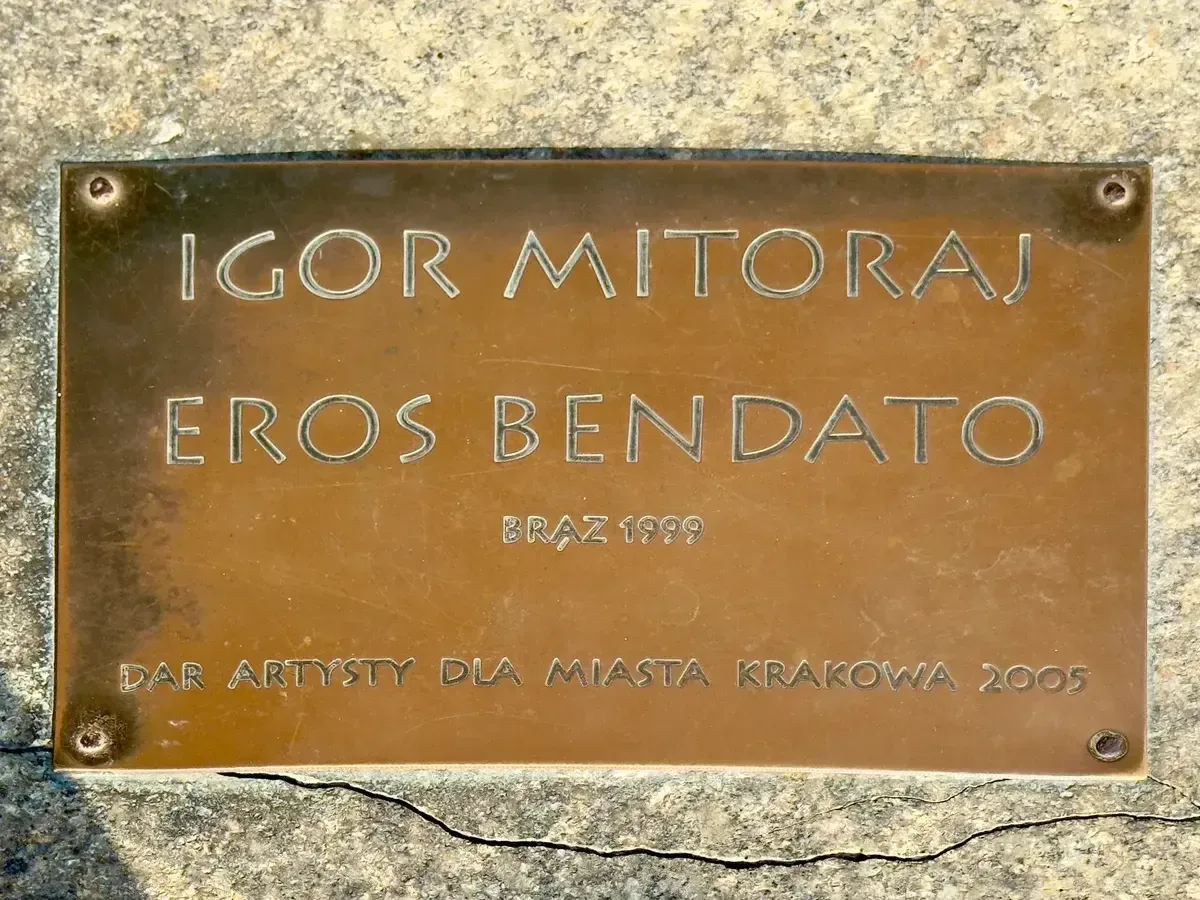
Igor Mitoraj Eros Bendato monumental bronze head, Rynek Główny, Kraków — gifted to the city 2005, edition of 3
Photo: Chris Olszewski (Kgbo), CC BY-SA 4.0
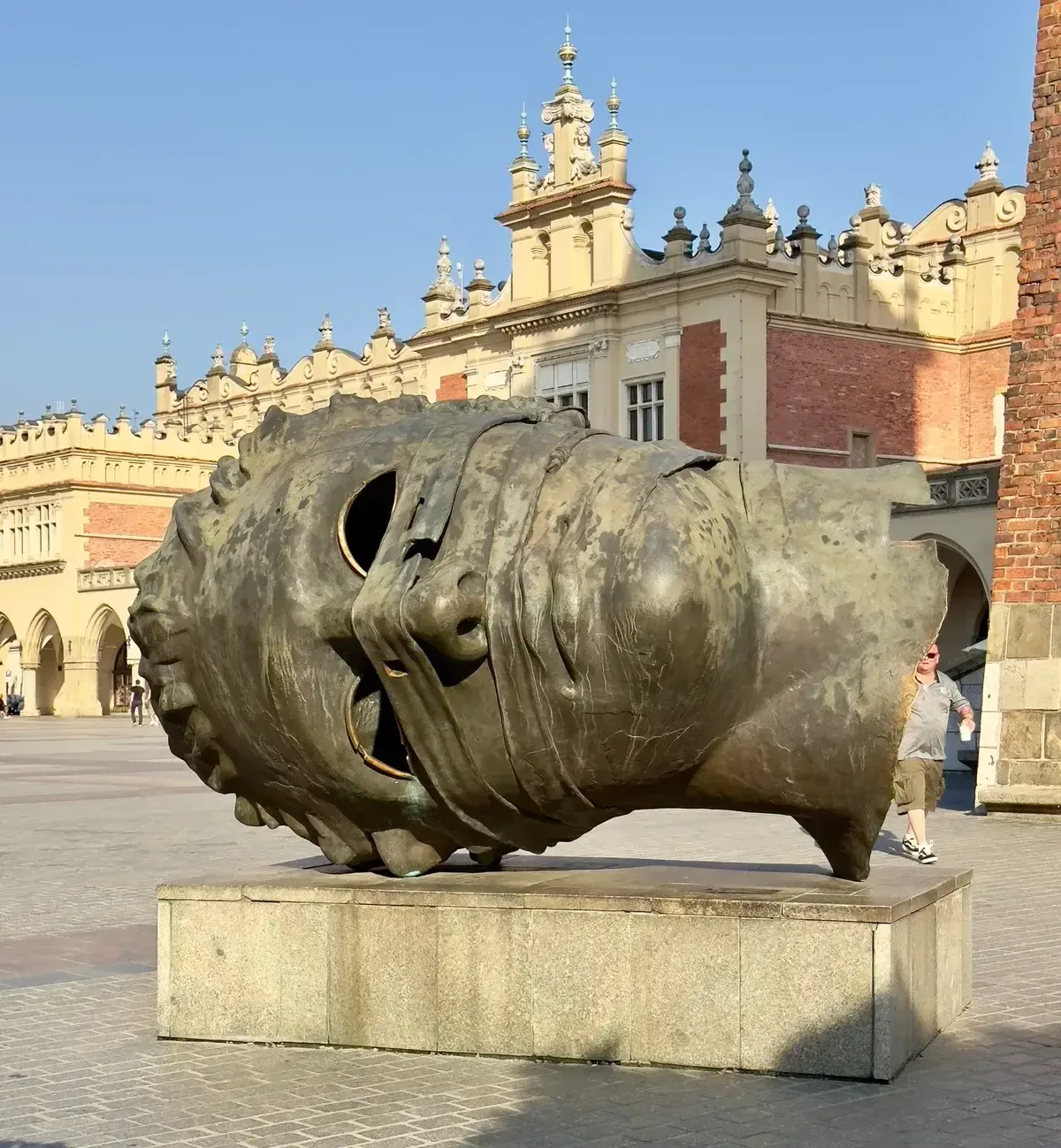
Igor Mitoraj Eros Bendato bronze head sculpture, Kraków Main Market Square — 370 × 290 cm, 1900 kg
Photo: Dennis Jarvis, CC BY-SA 2.0

Eros Bendato — "Eros Bound" — is the most visited contemporary sculpture in Poland. A colossal bronze head of Eros, the Greek god of love and desire, lies on its side on the pavement of the Main Market Square near the Town Hall Tower. The face is bound with two horizontal strips of bronze, covering the eyes and suggesting imprisoned desires. The head is hollow — visitors have been photographed sticking their limbs through the eyeholes since the day it was installed.

The work was cast in 1999 in an edition of three: one went to Lugano, one to Kraków, and one was kept by the artist until his death in 2014. The Kraków copy was gifted during the 2003–2004 Main Square exhibition. Its placement caused immediate controversy — city historians and residents objected to a modern sculpture in the historic UNESCO-protected square; Mitoraj objected equally strongly to the initial plan to place it outside the Galeria Krakowska shopping centre, stating that his work did not belong in front of a commercial building. The dispute was eventually resolved in the work's favour, and it has stood near the Town Hall Tower since 2005.

Today it is affectionately known as Głowa (The Head). It serves as a meeting point, a landmark, a climbing frame for children, and — despite everything — one of the most genuinely beloved pieces of public art in any Polish city. Visitors come from across Europe specifically to see it.

→ View on Google Maps

📍 ul. Grodzka 53 — Collegium Luridicum Courtyard

Luci di Nara

Bronze · Permanent installation · Courtyard of Collegium Luridicum
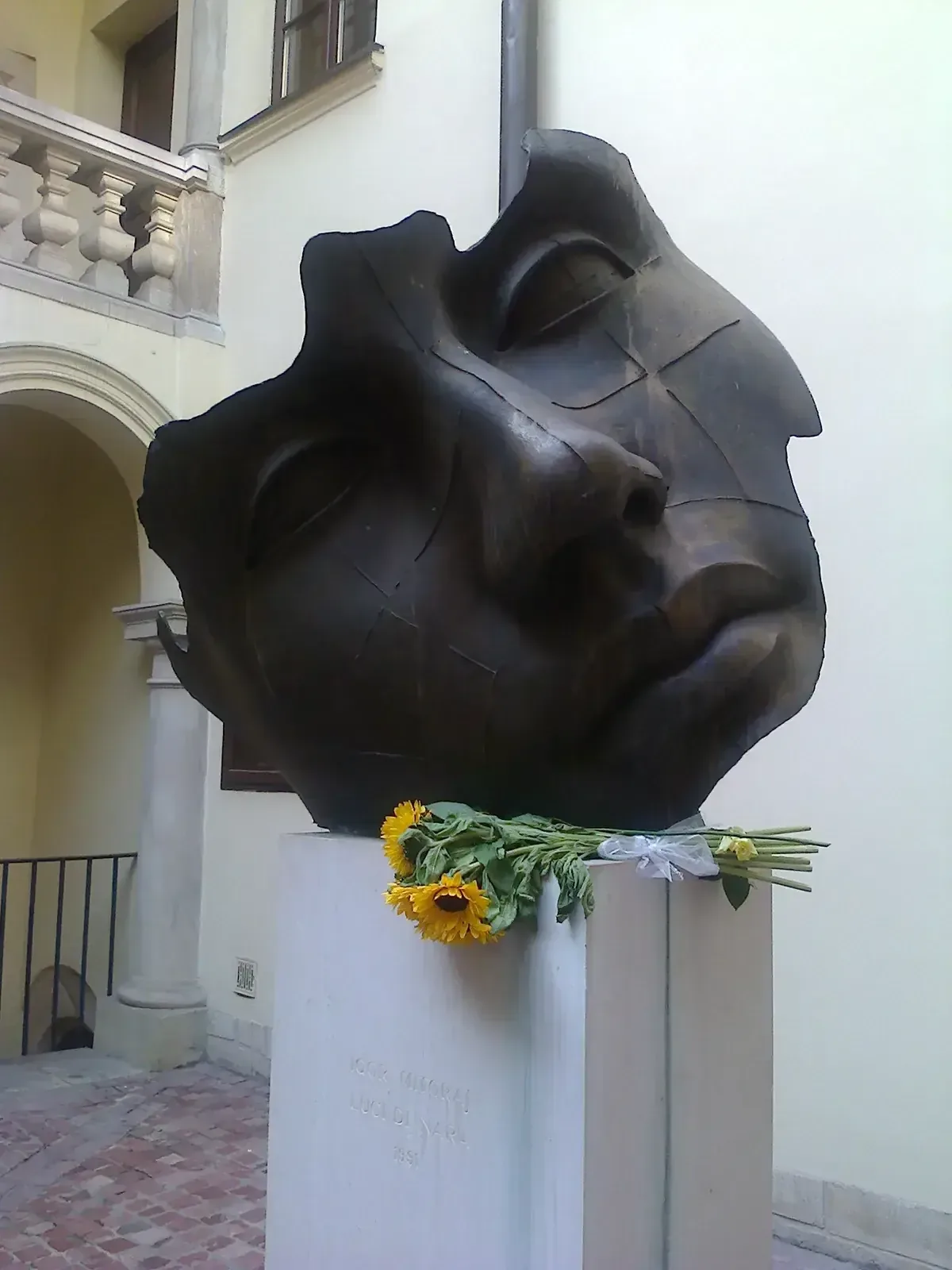
Igor Mitoraj Luci di Nara bronze sculpture, Collegium Luridicum courtyard, ul. Grodzka 53, Kraków — permanent installation
Photo: Dorja, CC0 — public domain

Luci di Nara (Lights of Nara) stands in the charming courtyard of Collegium Luridicum, the historic Jagiellonian University building on ul. Grodzka — just a few minutes' walk from the Main Square. This is a quieter, more contemplative encounter with Mitoraj's work than the public spectacle of Eros Bendato: the courtyard setting gives the sculpture an intimate, almost archaeological quality, as if it has always been there among the old stones.

The work is accessible during university opening hours. Unlike Eros Bendato, which is surrounded by thousands of tourists daily, Luci di Nara rewards visitors who seek it out — it is one of the less-documented Mitoraj works in Poland and rarely appears in tourism literature.

→ View on Google Maps

📍 ul. Lubicz 48 — Opera Krakowska

Sculpture at Kraków Opera

Bronze · Permanent installation · Forecourt of Opera Krakowska
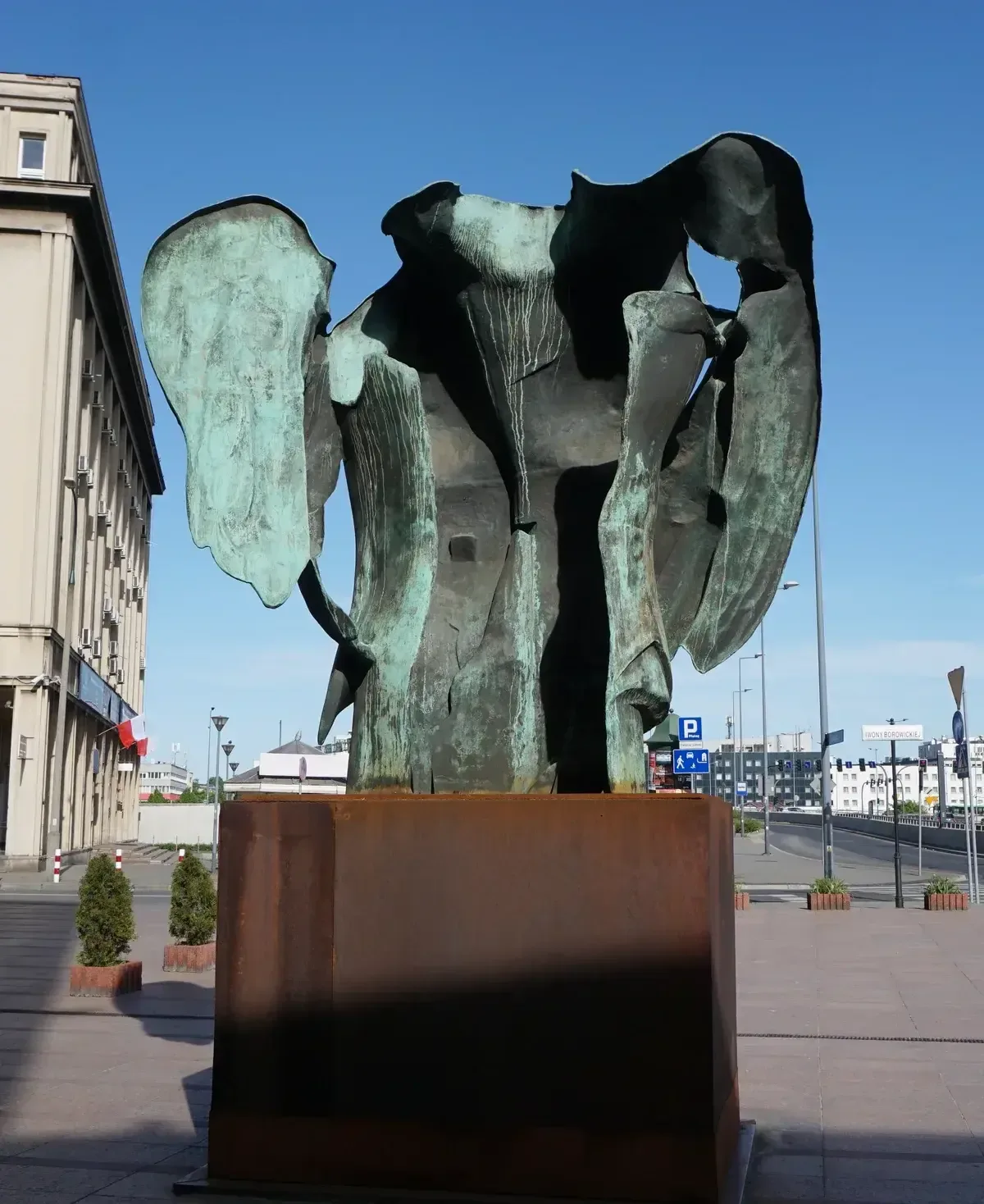
Igor Mitoraj Nascita di Eros bronze sculpture, forecourt of Opera Krakowska, ul. Lubicz 48, Kraków — permanent public art
Photo: Igor123121, CC BY 4.0

A third permanent Mitoraj work stands in front of the Opera Krakowska on ul. Lubicz 48, on the edge of the Planty park belt that rings the Old Town. The placement — outside a major cultural institution — is more in keeping with Mitoraj's own preference for his work's context. Opera, with its traditions of classical myth, theatrical spectacle, and the staged human body, is a natural home for his fragmentary figures.

Mitoraj himself designed opera sets and costumes throughout his career, including the celebrated 2009 staging of Verdi's Aida in the Boboli Gardens in Florence. The Kraków Opera sculpture connects his visual art to his lifelong engagement with the operatic tradition.

→ View on Google Maps

Mitoraj's relationship with Kraków deepened considerably after the 2003–2004 exhibition. The Jagiellonian University's Collegium Maius holds archival material documenting his student years at the Academy of Fine Arts, where he studied painting under Tadeusz Kantor before shifting decisively toward sculpture in the early 1970s. That transition — from painter to monumental bronze-caster — is considered one of the more significant pivots in postwar Polish art history. Collectors acquiring works from his Kraków period, particularly bronzes produced between 1999 and 2005, should note that Mitoraj typically cast in small numbered editions of three to six; provenance documentation from the Pietrasanta foundry in Tuscany, where most late works were cast, is the primary authentication reference used by European auction houses today.

Mitoraj's 2003–2004 Kraków exhibition marked a turning point in his institutional recognition in Poland. Prior to it, his work was largely celebrated abroad — in Paris, Rome, and Tokyo — while remaining little known to Polish audiences. The exhibition, organised in partnership with the Kraków city authorities and the Foksal Gallery Foundation, drew an estimated 800,000 visitors over its three-month run, an extraordinary figure for a temporary sculpture show in Central Europe. Several of the fourteen works displayed, including Tindaro Screpolato and Perseo, were later acquired by European private collectors, with bronze editions from that period now appearing regularly at auction through houses such as Sotheby's and Bonhams. The exhibition catalogue, published in Polish and Italian, has itself become a sought-after collector's item, with signed copies occasionally surfacing through Kraków antiquarian booksellers.

Beyond the Main Market Square, Kraków holds a quieter claim on Mitoraj's biography: it was here, in the late 1950s and early 1960s, that he first encountered the ancient Mediterranean world through reproductions and casts at the Academy of Fine Arts, planting the seeds of an obsession that would define his entire output. Collectors seeking works connected to the Kraków chapter of his career should note that the 2003–2004 exhibition catalogue, published by the city in a limited print run, has become a reference document in its own right — it includes installation photographs, Mitoraj's handwritten notes on placement, and an essay by curator Józef Grabski that remains one of the most precise accounts of the artist's working method in monumental bronze. Original copies surface occasionally at Polish antiquarian fairs and through Kraków-based dealers specialising in post-war Central European art. Condition varies significantly; copies retaining the original unbound supplement of technical drawings command a consistent premium among serious Mitoraj collectors.

Beyond the Main Market Square, Kraków holds a quieter but significant place in Mitoraj's biography: the city's Manggha Museum of Japanese Art and Technology hosted a focused retrospective in 2013, the year before his death, drawing collectors and curators from Warsaw, Vienna, and Milan who were tracing the late evolution of his bronze work. Mitoraj studied at the Academy of Fine Arts in Kraków from 1963 to 1968 under Jerzy Nowosielski in painting before pivoting decisively to sculpture during his 1968 French government scholarship to Paris — a transition that Kraków-based art historians argue the city's rich classical architectural environment quietly prepared him for. The Jagiellonian University's Collegium Maius collection holds archival photographs and correspondence documenting his student years, accessible to researchers by appointment. For collectors, works connected to the 2003–2004 Kraków exhibition carry particular provenance interest: the exhibition catalogue, produced in a limited print run with an introduction by art critic Marek Rostworowski, is now itself a sought-after document among specialists in postwar Polish and Italian cross-cultural art. Auction appearances of that catalogue through Warsaw's Polswiss Art house have seen it reach multiples of its original cover price.

Kraków's relationship with Mitoraj extended well beyond the landmark 2003–2004 exhibition. The Cricoteka — the archive and research centre dedicated to Tadeusz Kantor, under whom Mitoraj studied at the Academy of Fine Arts in the late 1960s — holds documentary material tracing Mitoraj's early development, making Kraków an essential stop for serious researchers of his formative period. Collectors seeking works connected to this phase of his career should note that small-edition bronzes from the 1970s and early 1980s, produced before Mitoraj relocated permanently to Paris and later Pietrasanta, surface only rarely at auction and almost exclusively through Polish private estates. The 2003–2004 Main Square exhibition catalogue, published by the city of Kraków in a limited print run, has itself become a collector's document: it contains installation photographs, dimension records, and a preface by Mitoraj that remains one of the most candid statements he made about his relationship with Poland and with his own displacement. Signed copies occasionally appear through Kraków antiquarian dealers, particularly along ulica Św. Jana. The Jagiellonian University Museum at Collegium Maius, a short walk from Eros Bendato, holds no Mitoraj works in its permanent collection but has periodically displayed archival loan material connecting the sculptor's classical influences to the broader humanist tradition that the university, founded in 1364, has long embodied.

Beyond the permanent installation on the Main Market Square, Kraków holds a second, quieter claim on Mitoraj's biography: it was here, at the Academy of Fine Arts on ul. Smoleńsk, that he studied painting under Jerzy Nowosielski before transferring to the studio of Tadeusz Kantor, whose radical theatre and assemblage work pushed the young Mitoraj toward three-dimensional form. He left Kraków for Paris in 1968, a departure that proved permanent, yet the city remained a recurring point of reference in interviews throughout his career. Collectors seeking works with a documented Kraków provenance should note that several bronzes from the 2003–2004 exhibition were offered privately following the show's close, with at least two mid-scale works — including a version of Testa di Cavallo — passing through the Kraków secondary market in the years immediately after. Auction records from Desa Unicum, Poland's principal fine-art auction house, show that Mitoraj bronzes have consistently commanded between 80,000 and 350,000 PLN at Warsaw sales since 2010, with the strongest results attached to works carrying exhibition history in Polish venues. The Collegium Luridicum courtyard installation of Luci di Nara, accessible during Jagiellonian University open hours, is one of the few Mitoraj bronzes in Poland displayed in an intimate architectural setting rather than open public space, which tends to make it a preferred subject among serious collectors visiting the city who wish to study the relationship between his surfaces and controlled natural light. The Jagiellonian University Museums office on ul. Jagiellońska can confirm current access arrangements, which vary seasonally.

Beyond the Main Market Square, Kraków holds a quieter claim on Mitoraj's biography: it was here, between 1963 and 1968, that he studied painting under Tadeusz Kantor at the Academy of Fine Arts before abandoning painting entirely for sculpture in the early 1970s following a pivotal trip to Mexico. That biographical arc — from Kraków student to internationally exhibited sculptor — gives the city's holdings a resonance that purely civic acquisitions rarely carry. The 2003–2004 exhibition, formally titled Igor Mitoraj. Sculptures, was organised in partnership with the City of Kraków and drew an estimated 800,000 visitors over its three-month run, figures that persuaded city authorities to pursue a permanent acquisition rather than allow all works to be returned. Collectors and institutions tracking Mitoraj's market should note that the Kraków gift represented a deliberate authorial choice: Mitoraj consistently distinguished between works he considered appropriate for civic, open-air settings and those he reserved for private or gallery sale, and the bronzes placed in Polish public collections were in almost every case gifted or offered at well below secondary-market valuations. On the secondary market, comparable large-format bronze heads from the same 1999 casting period — works of similar scale to Eros Bendato — have achieved between €180,000 and €420,000 at European auction houses including Sotheby's Paris and Dorotheum Vienna, depending on edition number, surface patination, and provenance documentation. Smaller works associated with the Kraków period, particularly preparatory maquettes and works on paper from the 1990s, occasionally surface through Polish regional auction houses such as Agra-Art and Desa Unicum in

Beyond the Main Market Square, Kraków holds a quieter but significant place in Mitoraj's biography: it was here, at the Academy of Fine Arts, that he trained under Jerzy Nowosielski before later studying under Tadeusz Kantor, and the city's medieval stone — its eroded cornices, worn column bases, and fractured Gothic ornament — left a permanent imprint on his formal vocabulary. Collectors and scholars who visit Kraków specifically to trace that influence often note the visual rhyme between the limestone detailing of St. Mary's Basilica and the deliberately abraded surfaces Mitoraj developed in his Carrara marble period of the 1980s and early 1990s. Works from that period — pieces such as Testa di Centauro and Perseo — command the strongest prices at auction, with documented sales at Sotheby's and Christie's placing finished marble sculptures from this decade consistently above €80,000, and exceptional examples exceeding €300,000. The bronze editions, by contrast, offer a wider entry point for collectors: smaller cast works from authorised editions of eight or twelve, produced in foundries in Pietrasanta, have appeared at Polish auction houses including Desa Unicum and Agra-Art in Warsaw at estimates beginning around €15,000–25,000, making them among the more accessible works by a sculptor of Mitoraj's international standing. For those researching provenance, it is worth noting that works exhibited in Kraków during the landmark 2003–2004 exhibition are well documented: the city's Historical Museum holds photographic and curatorial records of all fourteen pieces displayed in the square, and these records have been consulted in authentication discussions for works that subsequently entered private hands. The

Beyond the permanent installation at Collegium Luridicum and the iconic Eros Bendato, Kraków retains a deeper institutional connection to Mitoraj through the Academy of Fine Arts on Smoleńsk Street, where he studied under Jerzy Nowosielski in the painting faculty before transferring his focus to sculpture following a formative trip to Mexico in 1968 — an encounter with pre-Columbian form that redirected the rest of his career. The Academy periodically exhibits archival material relating to its most internationally recognised graduate, and scholars researching his Polish period have found the institution's records useful in tracing the early development of his vocabulary of fragmentation. Collectors with a particular interest in works that predate his Italian period — Mitoraj settled in Pietrasanta in Tuscany in 1983, where he remained until his death on October 6, 2014 — should note that small bronzes and works on paper from the 1970s occasionally surface through Polish auction houses, most notably Desa Unicum in Warsaw, which has handled several early works and typically provides the most reliable provenance documentation for pieces originating in his Kraków years. Prices for verified early works have risen steadily since 2015, reflecting both the posthumous consolidation of his market and the relatively limited supply of pieces with clear pre-Pietrasanta provenance. The 2003–2004 Main Market Square exhibition itself generated significant documentary material — catalogues, press photography, and correspondence between the city and the artist's studio — some of which has entered private hands and represents a distinct category of collectible for those focused on the archival rather than the sculptural. One underappreciated aspect of Kraków's relationship with Mitoraj is the city's role as a secondary market hub: because

Beyond the two permanent works in Kraków's public spaces, the city retains a deeper archival significance for collectors tracing Mitoraj's development. The Manggha Museum of Japanese Art and Technology, located on the south bank of the Vistula near Wawel Castle, held documentary exhibitions in the mid-2000s that contextualised Mitoraj's early encounter with Eastern aesthetics alongside his classical European training — a pairing that illuminates why his mature bronze figures so often read as simultaneously ancient and otherworldly. Mitoraj studied at the Kraków Academy of Fine Arts from 1963 to 1968 under Tadeusz Kantor, whose theatrical approach to fragmented bodies and masked identity left a traceable imprint on works such as Testa Addormentata and Perseo. Collectors acquiring works from the 1970s and early 1980s — the period immediately following Mitoraj's departure from Poland to Paris and then Mexico, where the pre-Columbian ruins of Teotihuacán proved transformative — should be aware that editions from this formative decade are among the rarest on the secondary market, partly because Mitoraj's commercial gallery relationships were not yet formalised and edition sizes were kept very small. The Galerie Ror Volmar in Paris, which began representing Mitoraj in the late 1970s, placed a number of these early works with French and Swiss private collectors, and they surface occasionally at Sotheby's and Bonhams rather than at the specialist Italian houses that handle his better-known Pietrasanta-period bronzes. Kraków's National Museum holds a small but important group of works on paper — drawings and gouaches — that document the transit

ミトライ作品をお持ちですか?

ワルシャワのプライベートコレクターが直接購入します。オークション手数料なし。迅速・秘密厳守。

Any other Mitoraj work also welcome — any subject, condition, or format.

Mitoraj in Other Cities

Warsaw Poznań Paris Rome Pietrasanta → All cities
WhatsApp Email Me
Add to your home screen