
Igor Mitoraj em Cracóvia

para abrir o WhatsApp — depois
envie as fotos diretamente.
Cracóvia é onde Mitoraj se tornou artista. Estudou aqui, expôs aqui e acabou por oferecer à cidade a sua escultura contemporânea mais visitada. Hoje Cracóvia possui quatro obras permanentes de Mitoraj — mais do que qualquer cidade polaca exceto Varsóvia — e o Museu Nacional guarda peças da sua carreira inicial. Este é um guia completo de onde encontrá-las.
Cracóvia moldou Mitoraj profundamente. Estudou na Academia de Belas-Artes sob Tadeusz Kantor — um dos mais influentes artistas polacos do século XX — antes de partir para Paris em 1968. O seu regresso a Cracóvia em 2003–2004 com uma exposição de catorze obras no Rynek Główny foi simultaneamente um regresso a casa e um triunfo. O Luci di Nara no pátio do Collegium Luridicum (ul. Grodzka 53) e o bronze na Ópera de Cracóvia (ul. Lubicz 48) complementam o famoso Eros Bendato na praça principal, tornando Cracóvia a cidade polaca com a maior concentração de obras permanentes ao ar livre de Mitoraj.
Cracóvia & Mitoraj — Um Laço Biográfico
Igor Mitoraj chegou a Cracóvia em 1963 com dezenove anos, inscrevendo-se na Academia de Belas-Artes sob o lendário Tadeusz Kantor — pintor, encenador teatral e o artista polaco mais importante da sua geração. A influência de Kantor foi decisiva: a sua ênfase no objeto, no corpo como presença simultaneamente real e teatral, e no poder da fragmentação percorre todas as esculturas que Mitoraj alguma vez realizou.
Mitoraj deixou Cracóvia em 1968, mudando-se para Paris e estabelecendo eventualmente o seu ateliê em Pietrasanta, Itália. Não regressou à Polónia em qualquer sentido artístico significativo até 2003 — trinta e cinco anos depois — quando a cidade o convidou a instalar catorze esculturas monumentais no Rynek Główny (Praça Principal do Mercado). A exposição decorreu de 17 de outubro de 2003 a 25 de janeiro de 2004 e foi uma das maiores exposições individuais alguma vez montadas numa praça pública europeia. No seu encerramento, Mitoraj ofereceu o Eros Bendato à cidade — um gesto que se tornou anos de controvérsia e acabou por criar a obra de arte contemporânea mais fotografada de Cracóvia.
Cronologia de Mitoraj em Cracóvia
Mitoraj inscreve-se na Academia de Belas-Artes de Cracóvia, sob Tadeusz Kantor. Estuda pintura; os primeiros experimentos escultóricos têm início.
Primeira exposição individual na Galeria Krzysztofory, Cracóvia — principalmente pinturas e obras iniciais em papel.
Parte de Cracóvia para Paris para continuar os estudos na École Nationale Supérieure des Beaux-Arts. Não regressa à Polónia profissionalmente durante 35 anos.
Catorze esculturas monumentais instaladas no Rynek Główny (17 Out 2003 – 25 Jan 2004). A exposição é uma das maiores mostras individuais ao ar livre da história europeia. Mitoraj oferece o Eros Bendato à cidade de Cracóvia.
O Eros Bendato é instalado permanentemente perto da Torre da Câmara Municipal na Praça Principal, após longo debate sobre a sua colocação. Sensação pública imediata.
A Academia de Belas-Artes de Cracóvia atribui a Mitoraj o título de Doutor Honoris Causa — o seu mais alto reconhecimento, em homenagem ao papel formativo da cidade na sua carreira.
Eros Bendato (Eros Acorrentado) — 1999
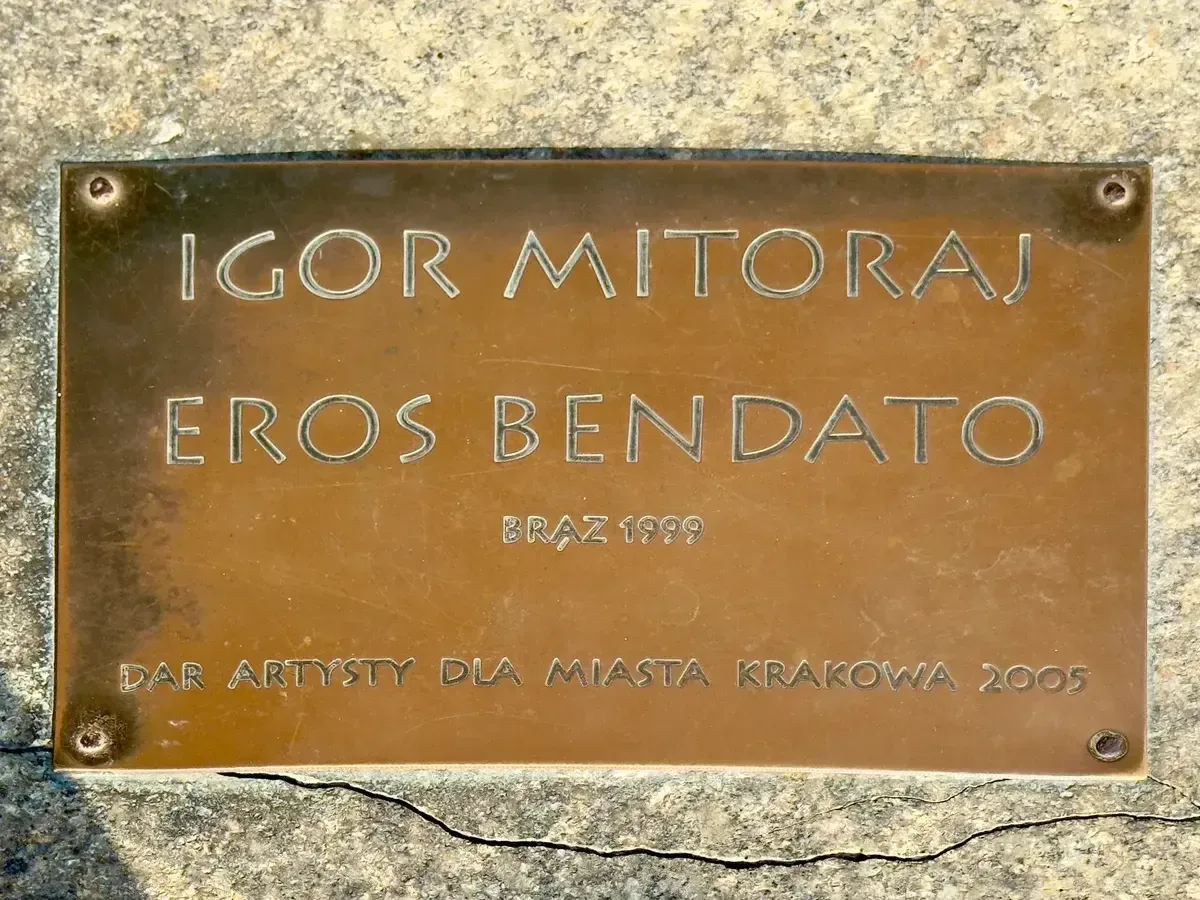
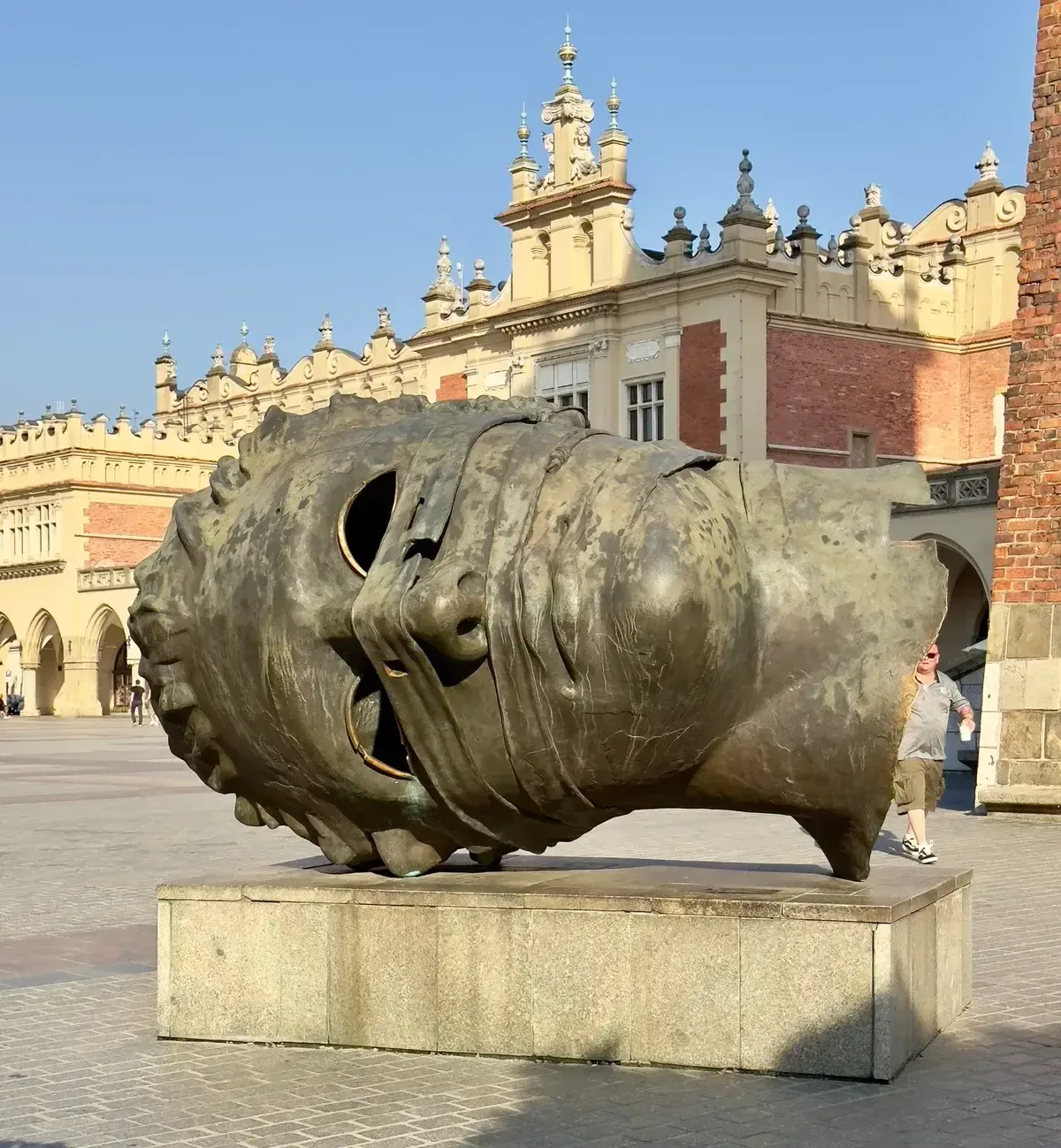
O Eros Bendato — "Eros Acorrentado" — é a escultura contemporânea mais visitada da Polónia. Uma colossal cabeça em bronze de Eros, o deus grego do amor e do desejo, jaz de lado no pavimento da Praça Principal do Mercado, perto da Torre da Câmara Municipal. O rosto está ligado com duas faixas horizontais de bronze, cobrindo os olhos e sugerindo desejos aprisionados. A cabeça é oca — visitantes têm sido fotografados a enfiar os membros pelos buracos dos olhos desde o dia em que foi instalada.
A obra foi fundida em 1999 numa edição de três: uma foi para Lugano, uma para Cracóvia e uma ficou com o artista até à sua morte em 2014. O exemplar de Cracóvia foi oferecido durante a exposição de 2003–2004 na Praça Principal. A sua colocação gerou imediata controvérsia — historiadores e residentes da cidade opuseram-se a uma escultura moderna na praça histórica protegida pela UNESCO; Mitoraj opôs-se igualmente com veemência ao plano inicial de a colocar em frente à galeria comercial Galeria Krakowska, afirmando que a sua obra não pertencia a um edifício comercial. A disputa foi eventualmente resolvida em favor da obra, e esta tem estado perto da Torre da Câmara Municipal desde 2005.
Hoje é carinhosamente conhecida como Głowa (A Cabeça). Serve de ponto de encontro, marco de referência, brinquedo de escalar para crianças e — apesar de tudo — uma das peças de arte pública genuinamente amadas em qualquer cidade polaca. Visitantes vêm de toda a Europa especialmente para a ver.
Luci di Nara
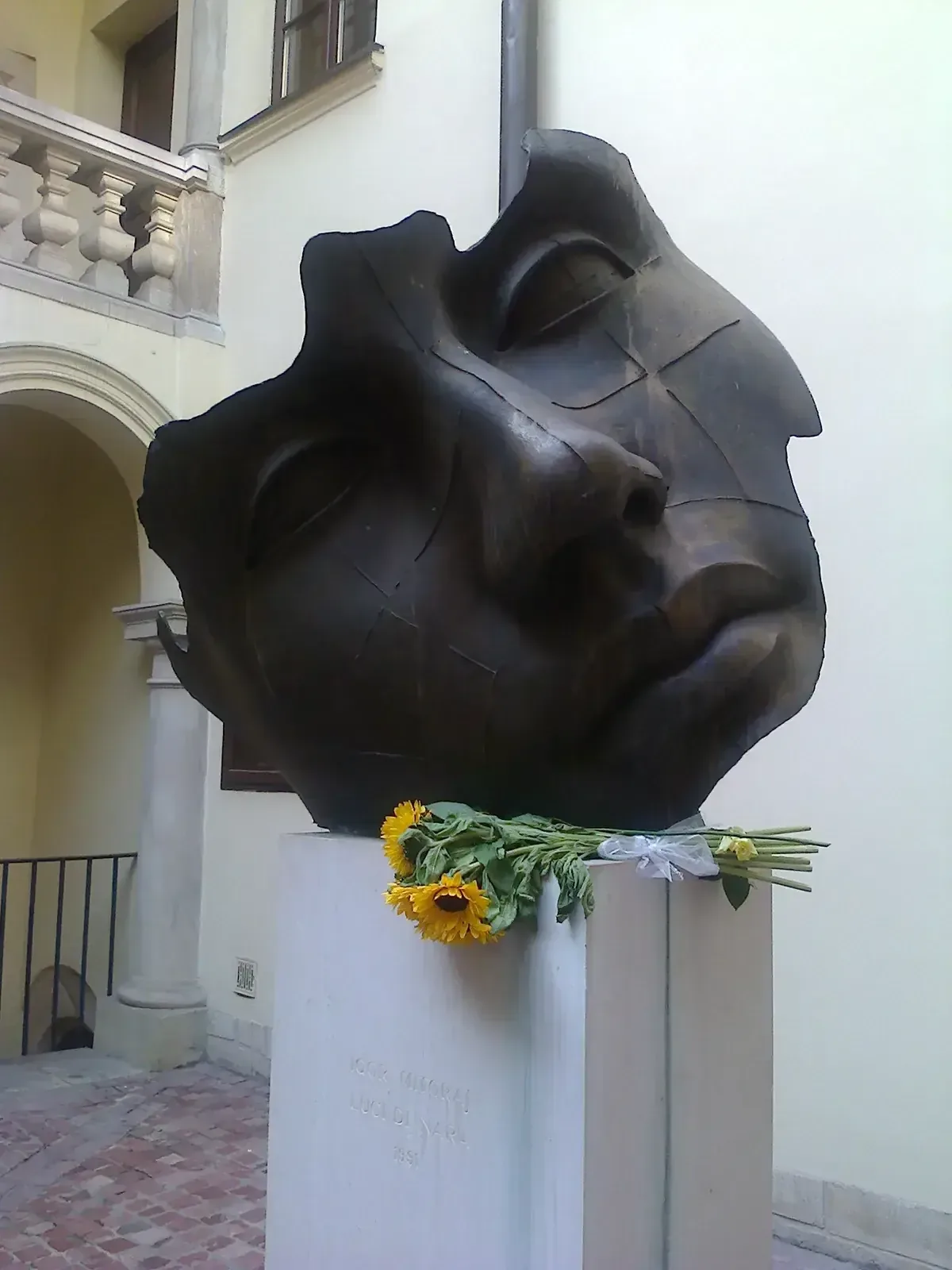
O Luci di Nara (Luzes de Nara) ergue-se no encantador pátio do Collegium Luridicum, o histórico edifício da Universidade Jagielónica na ul. Grodzka — a poucos minutos a pé da Praça Principal. Este é um encontro mais silencioso e contemplativo com a obra de Mitoraj do que o espetáculo público do Eros Bendato: o contexto do pátio dá à escultura uma qualidade íntima, quase arqueológica, como se sempre tivesse estado ali entre as pedras antigas.
A obra é acessível durante o horário de funcionamento da universidade. Ao contrário do Eros Bendato, rodeado diariamente por milhares de turistas, o Luci di Nara recompensa os visitantes que o procuram — é uma das obras de Mitoraj menos documentadas na Polónia e raramente aparece na literatura turística.
Escultura na Ópera de Cracóvia
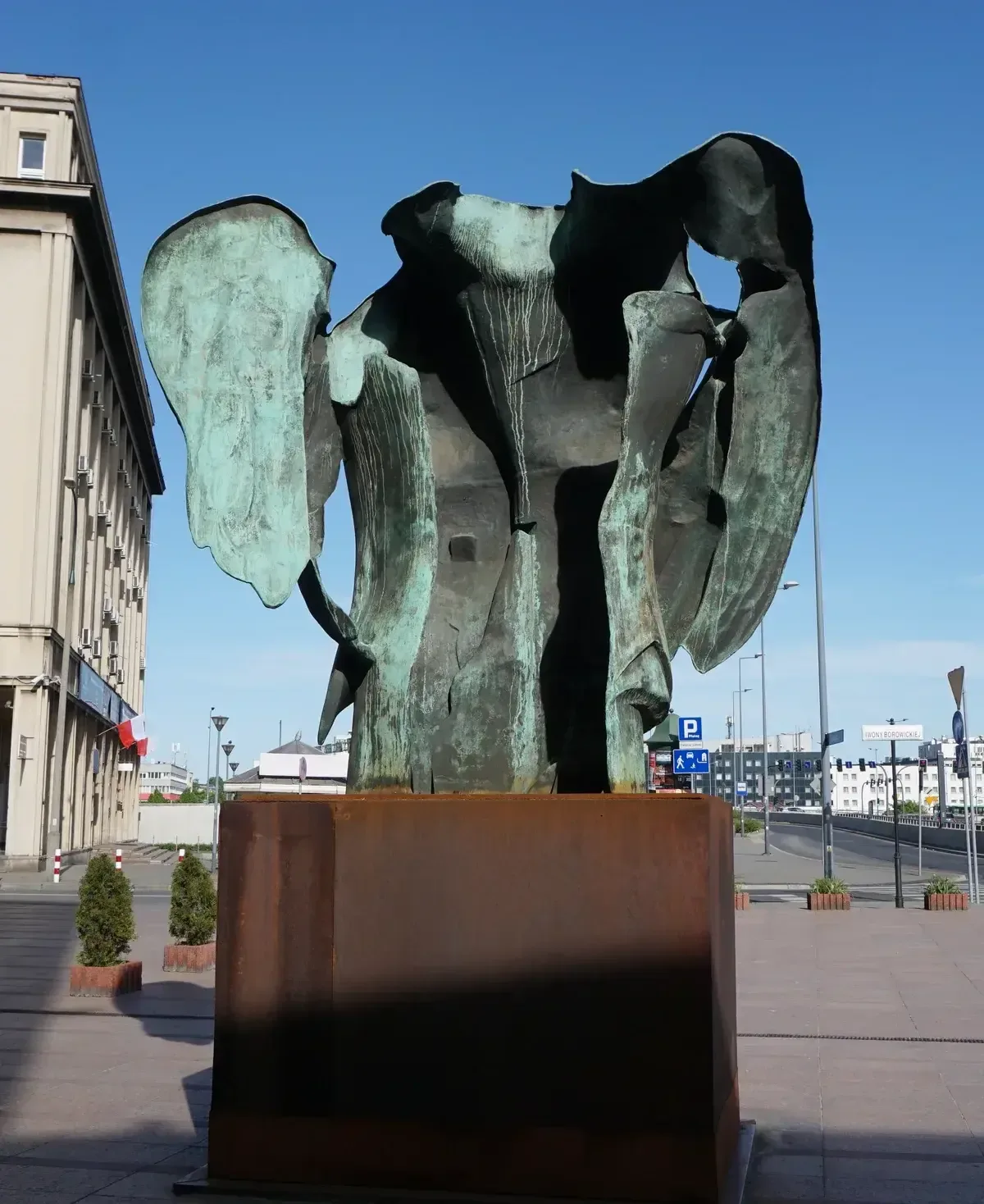
Uma terceira obra permanente de Mitoraj ergue-se em frente à Opera Krakowska, na ul. Lubicz 48, à beira do cinturão de parques Planty que rodeia a Cidade Velha. A colocação — em frente a uma grande instituição cultural — está mais de acordo com a própria preferência de Mitoraj pelo contexto da sua obra. A ópera, com as suas tradições de mito clássico, espetáculo teatral e o corpo humano encenado, é um lar natural para as suas figuras fragmentárias.
O próprio Mitoraj concebeu cenários e figurinos de ópera ao longo da sua carreira, incluindo a célebre encenação de 2009 da Aída de Verdi nos Jardins de Boboli em Florença. A escultura da Ópera de Cracóvia liga a sua arte visual ao seu envolvimento ao longo da vida com a tradição operática.
Muzeum Narodowe w Krakowie (Museu Nacional)
O Muzeum Narodowe w Krakowie (Museu Nacional de Cracóvia) possui obras de Igor Mitoraj na sua coleção permanente — a mais significativa detenção institucional da sua obra na Polónia depois do Atelier Mitoraj em Pietrasanta. A coleção do museu abrange a arte polaca desde o período medieval até à atualidade, e a posição de Mitoraj nela reflete o seu estatuto de escultor polaco mais internacionalmente reconhecido do século XX.
Para os colecionadores, o Museu Nacional fornece o contexto institucional autorizado para a obra de Mitoraj na Polónia: a sua relação com a Academia de Cracóvia, a sua posição na história da arte polaca do pós-guerra e a receção crítica das suas esculturas monumentais estão todos documentados nos recursos académicos do museu.
Cracóvia & o Mercado de Mitoraj
Cracóvia ocupa um lugar particular no mercado colecionador de Mitoraj. A população culta e culturalmente envolvida da cidade produziu alguns dos mais sérios colecionadores privados da sua obra em toda a Polónia — pessoas que cresceram com a Głowa na Praça Principal, que estudaram na Academia onde Mitoraj se formou, e que compreendem a sua obra por dentro em vez de a ver como uma importação internacional.
Os compradores polacos — particularmente os baseados em Cracóvia e Varsóvia — têm sido alguns dos licitantes mais competitivos nas leiloeiras europeias nos últimos cinco anos. O recorde de Varsóvia de 2025 de PLN 6,89 milhões pelo Tindaro foi significativamente impulsionado pela procura institucional e privada polaca. Para quem em Cracóvia possui uma obra de Mitoraj e está a considerar vender, a via da venda privada — diretamente a um colecionador sério — continua a ser a opção mais eficiente e discreta.
Sou um colecionador particular baseado em Varsóvia, a adquirir ativamente obras de Mitoraj de todos os tipos. Se possui um bronze, mármore, litografia ou desenho de Igor Mitoraj — qualquer formato, qualquer estado — gostaria de saber.
The 2003–2004 Kraków installation marked a turning point in how the secondary market valued Mitoraj's bronzes tied to Polish subjects. Works from the same casting period as the monumental pieces shown on Rynek Główny — including smaller editions of Eros Bendato and the related Testa di Centauro — began appearing with greater frequency at Polish auction houses after 2005, with Dom Aukcyjny Agra-Art in Warsaw handling several notable lots in the years following the exhibition. Collectors who had acquired Mitoraj pieces during his earlier Parisian period, roughly 1968 to 1983, found that provenance connecting a work to his pre-Pietrasanta phase commanded a measurable premium, as these earlier bronzes — often smaller in scale and less finished in their patination — document a formative vocabulary that the later monumental career refined rather than abandoned. The Kraków connection carries particular weight for Polish private collectors, for whom the Academy of Fine Arts remains a resonant institutional address: Mitoraj studied there under Tadeusz Kantor from 1963 until his departure in 1968, and the school's archive holds documentary materials from that period, including early drawings and academic correspondence, which have been consulted by researchers preparing catalogue raisonné entries. The National Museum in Kraków, housed across several buildings including the main site on Aleja 3 Maja, holds works from Mitoraj's early career in its permanent collection, making it one of the few Polish institutions where his development before the Italian marble and bronze period can be studied in person. For collectors researching authenticity, the Fondazione Mitoraj, established to protect and document the estate following his death in Pietrasanta on
The 2003–2004 Kraków installation did more than mark Mitoraj's return to Poland — it fundamentally repositioned him in the European sculpture market. Prior to the Rynek Główny exhibition, his work circulated primarily through Italian and French galleries, with Galleria Forni in Bologna and Galerie Daniel Templon in Paris serving as his principal commercial outlets. The monumental public exposure in Kraków introduced his vocabulary of fragmented classical forms to a Central European collector base that had previously had little access to his bronzes. Auction records from the years immediately following the exhibition show a measurable uptick in Polish private acquisitions, particularly of his smaller cabinet-scale works — the tabletop fragments of helmeted heads and winged torsos that translate his monumental language into objects suited to domestic interiors. Collectors seeking entry points into his market today generally focus on these editions, which were cast in limited runs at the Pietrasanta foundries he worked with from the late 1970s onward. Works from the 1980s and early 1990s — the period when Mitoraj was refining his signature treatment of cracked and bandaged antiquity — tend to command the strongest prices at secondary market, with pieces from this decade appearing at Sotheby's, Christie's, and Dorotheum with increasing regularity since his death in Kraków on 6 September 2014. The fact that he died in the city where he had trained carries a biographical weight that auction cataloguers have not overlooked; provenance narratives connecting works to his Polish years carry a distinct premium. For visitors to Kraków with a serious collecting interest, the Muzeum Narodowe w Krakowie holdings — which include works predating his departure for Paris — offer a rare opportunity to study his development before the classical motifs
The 2003–2004 Kraków installation marked a turning point in how the secondary market valued Mitoraj's bronze editions. Before the Rynek Główny exhibition, his work circulated primarily through a small network of Italian and French galleries, with auction appearances concentrated at Sotheby's and Christie's Paris. After the public exposure in Kraków — where an estimated two million visitors encountered the sculptures over the three-month run — collector interest in Central and Eastern Europe expanded measurably. Dealers in Warsaw and Prague began acquiring bronzes from the Pietrasanta foundry editions with greater regularity, and Polish private collections that had previously focused on painting started to include Mitoraj sculpture as a distinct category. For collectors researching provenance, it is worth knowing that Mitoraj worked with a small number of authorised foundries throughout his career, most consistently with the Fonderia Mariani in Pietrasanta, and that edition sizes on his major bronze series were typically kept between six and twelve casts, with an artist's proof and occasionally a foundry proof in addition. Works from the early Kraków period — paintings and graphic works produced between 1963 and 1968 under Kantor's supervision — are considerably rarer than the mature bronzes and seldom appear at auction; when they do surface, they tend to do so through Polish auction houses such as Desa Unicum in Warsaw rather than through the major international rooms. The Muzeum Narodowe w Krakowie (National Museum in Kraków) holds several works from this formative period, and while these are not available for acquisition, they serve as an important reference point for authenticating early works on paper and establishing stylistic continuity with the later sculpture. Collectors visiting Kraków should also note that the museum's permanent collection display is housed across multiple buildings;
The 2003–2004 Kraków installation marked a turning point in how the secondary market valued Mitoraj's bronzes, and collectors who attended the Rynek Główny exhibition in person have since noted that the works displayed there — monumental in scale, patinated to a warm ochre-brown against the limestone facades of the medieval square — represented a distinct phase in his casting practice. Mitoraj was working closely at that time with the Fonderia Mariani in Pietrasanta, one of the few foundries in Europe capable of realising his largest heads at true monumental scale, and the technical ambition of the Kraków pieces is visible in the thickness of the bronze walls and the deliberate roughness left at the cut edges, where the sculptor chose not to chase away the evidence of the mould. For collectors operating in the mid-range market, the most accessible entry point into Mitoraj's Kraków-connected work has historically been through the smaller numbered editions of heads and torsos produced between 1998 and 2006, many of which were exhibited at Galeria Starmach in Kraków — one of the first Polish commercial galleries to represent Mitoraj seriously in his homeland. Starmach's archive records show that several works from this period found permanent homes with Polish private collectors rather than institutions, a relatively unusual pattern for an artist of Mitoraj's international standing. The National Museum in Kraków, meanwhile, holds works that predate his Paris departure, including drawings and early sculptural studies from his time under Kantor that almost never appear at auction and remain effectively invisible to the market. Provenance connected to the 2003–2004 exhibition carries a modest premium at auction, particularly at Warsaw's Desa Unicum, where Mitoraj bronzes with documented Polish exhibition history have
The 2003–2004 Kraków installation marked a turning point not only for Mitoraj's relationship with Poland but for the secondary market for his bronzes in Central Europe. Before the Rynek Główny exhibition, Mitoraj's work was largely unknown to Polish collectors, his reputation having been built almost entirely through Italian and French galleries, particularly Antonia Jannone in Milan and the Galerie Lelong in Paris. The public spectacle of fourteen monumental bronzes occupying one of Europe's most visited medieval squares—drawing an estimated 1.2 million visitors over the three-month run—generated sustained collecting interest that persists today. Polish auction houses, including Desa Unicum in Warsaw and Agra-Art, have since handled multiple Mitoraj works at auction, with smaller bronzes from his classical fragmented series typically achieving between 80,000 and 250,000 PLN depending on size, casting date, and provenance. Collectors should note that Mitoraj supervised his foundry relationships closely: works cast at the Fonderia d'Arte Ferdinando Marinelli in Florence and the Fonderia Mariani in Pietrasanta carry the strongest market preference, and pieces bearing Mitoraj's personal stamp alongside the foundry mark are considered the most desirable by specialist buyers. Beyond the permanent outdoor works, the Muzeum Narodowe w Krakowie holds a small but significant group of Mitoraj's early paintings and graphic works from the late 1960s, predating his pivot to sculpture—these rarely appear at auction and offer collectors an unusual window into his formation under Kantor, when his visual language was still rooted in Polish avant-garde painting rather than Mediterranean classicism. The Kraków pieces also illustrate Mitoraj's deliberate approach to
The 2003–2004 Kraków installation marked a turning point not only for Mitoraj's Polish reception but for his market trajectory more broadly. Before the Rynek Główny exhibition, Mitoraj's name was well established among Italian and French collectors — his Pietrasanta bronzes had been circulating through galleries in Paris, Milan, and Geneva since the late 1980s — but Polish institutional interest had remained limited, partly because the communist-era cultural apparatus had little appetite for an émigré artist working in a figurative idiom indebted to antiquity rather than to socialist realism. The Kraków show changed that perception decisively. Polish private collectors, many of them newly wealthy after the economic transformations of the 1990s, encountered Mitoraj's monumental fragments for the first time at scale, and the demand for smaller, edition-scale bronzes rose noticeably in the years immediately following. Works such as Tindaro Screpolato and Perseo, which had already appeared in international auction rooms, began attracting Polish bidders in meaningful numbers after 2004. For collectors researching provenance, it is worth noting that Mitoraj worked closely with the Galleria d'Arte Il Gabbiano in Rome and with Contini Galleria, which has locations in Venice and Cortina d'Ampezzo; both galleries handled authenticated editions throughout the 1990s and 2000s and remain useful reference points when verifying the origin of works that entered the market during that period. The Kraków Academy of Fine Arts — where Mitoraj trained — holds archival material relating to his student years between 1963 and 1968, including early drawings and documentation of his studies under Kantor, and researchers have occasionally
The 2003–2004 Kraków installation was not Mitoraj's first contact with the Polish collector market, but it was the moment that crystallised serious domestic demand for his work. Prior to the Rynek Główny exhibition, Polish institutional acquisitions of Mitoraj had been modest and largely opportunistic; after it, the Desa Unicum auction house in Warsaw recorded a measurable increase in inquiries for his bronzes and works on paper, reflecting a broader pattern in which major public exhibitions consistently precede spikes in secondary-market activity for his editions. Collectors with serious interest in Mitoraj's Kraków period should be aware that his earliest documented work in the city — small-format paintings and experimental objects produced under Kantor's direction at the Academy between 1963 and 1968 — occupies a distinct category from his mature sculpture, and only a handful of these early pieces have ever appeared at auction. The Muzeum Narodowe w Krakowie (National Museum in Kraków) holds examples from this formative phase within its permanent collection, though they are not always on continuous public display and advance enquiry to the curatorial department is advisable before planning a visit specifically around them. For those whose interest is primarily sculptural, the permanent outdoor works reward repeated visits at different hours: Eros Bendato, cast in bronze and standing at the northern end of the Rynek Główny near the Cloth Hall, reads very differently under the low winter light of a January afternoon than it does in summer crowds, and long-term Kraków residents consistently note this perceptual variability as central to the work's enduring presence in the city's visual life. The bronze at the Kraków Opera on ul. Lubicz 48 — a site chosen partly for its institutional resonance
When the 2003–2004 Rynek Główny exhibition closed, the city of Kraków did not simply return all fourteen sculptures to Mitoraj's Pietrasanta foundry and move on. Three works were retained through a combination of municipal acquisition and private donation, establishing what has since become the most coherent open-air grouping of his bronzes in Central Europe. The most consequential of these was Eros Bendato, the large blindfolded head that now anchors the southwestern corner of the Main Market Square near the cloth hall, which the city formally acquired in 2004 for a reported sum in the region of 400,000 euros — a figure that, at the time, represented a significant institutional commitment to contemporary figurative sculpture at a moment when the international market for such work was still recovering its confidence after years of conceptual art dominance. For collectors and researchers visiting Kraków today, the sculpture functions as a kind of benchmark: it is one of the largest cast versions of this particular composition, and comparing it with the smaller bronzes that appear periodically at auction — typically at Desa Unicum in Warsaw, or occasionally at Christie's and Sotheby's in London — gives a direct sense of how Mitoraj calibrated scale to context throughout his career. The Desa Unicum auction house has handled a disproportionate share of Mitoraj's works on the Polish secondary market, with signed bronzes in the 40–80 centimetre range achieving hammer prices between 80,000 and 220,000 Polish złoty at major sales between 2015 and 2023, depending on subject, patina condition, and provenance clarity. Works that can be traced directly to Mitoraj's Pietrasanta studio, ideally accompanied by correspondence or a
The 2003–2004 Kraków installation marked a turning point not only for Mitoraj's public reputation in Poland but for the secondary market valuation of his bronzes more broadly. Prior to that exhibition, Mitoraj's work circulated primarily among Italian and French collectors familiar with the Pietrasanta foundry tradition, and auction appearances in Warsaw or Kraków were rare. After the Rynek Główny show drew an estimated several hundred thousand visitors over its three-month run, Polish institutional and private demand shifted measurably: works that had sold at modest estimates through Dorotheum and Christie's in the late 1990s began attracting competitive bidding from Central European buyers who had encountered the monumental pieces in person. Collectors researching Mitoraj's Kraków connection should note that the bronzes he produced during his student years at the Academy — roughly 1963 to 1968 — represent a category almost entirely distinct from his mature mythological output and are exceptionally scarce on the open market, since most were either destroyed, retained by the Academy, or passed into private Polish hands without documentation. The Muzeum Narodowe w Krakowie (National Museum in Kraków) holds examples from this formative period, including small-format figurative studies that predate his encounter with classical Mediterranean archaeology during his 1974 trip to Mexico, the journey widely credited with redirecting his aesthetic toward ancient fragmentation. Those student-era pieces, when they do surface — typically through regional Polish auction houses such as Agra-Art or Desa Unicum rather than the international salerooms — tend to be misattributed or offered without provenance, making specialist authentication essential. The Eros Bendato installed permanently in the Rynek Główny since 2005, a gift
The 2003–2004 Kraków exhibition marked a turning point not only for Mitoraj's relationship with Poland but for the secondary market for his bronzes across Central Europe. Before the Rynek Główny installation, Mitoraj's work was largely unknown to Polish collectors, who had little opportunity to encounter monumental bronze sculpture of this scale outside of Warsaw's institutional circuit. The exhibition changed that decisively. Polish auction houses, particularly Desa Unicum in Warsaw, began handling Mitoraj works with increasing regularity from around 2005 onward, and the prices achieved at Polish auction reflect a collector base that came of age seeing those fourteen sculptures dominate the medieval square for three winter months. Smaller cabinet bronzes and signed lithographs from Mitoraj's Pietrasanta studio — works that a serious collector can still acquire through specialist dealers in Kraków's Kazimierz district — represent the most accessible entry point into his market today, typically ranging from €4,000 to €18,000 depending on edition size and provenance documentation. The large unique bronzes and the artist's proof casts occupy an entirely different register, with significant examples having passed through Sotheby's Paris and Christie's London in the years following his death in October 2014. For collectors focused specifically on the Kraków connection, the most historically resonant acquisitions are works that can be traced to the 2003 exhibition itself, or to the preparatory studies Mitoraj made during his return visits to the city between 2001 and 2003. These studies, executed in clay and occasionally in plaster, were rarely editioned and exist in very small numbers; when they surface through Italian or French estate sales they carry considerable documentary interest beyond their market value. The Collegium Luridicum courtyard on ul. Grodz
Perguntas sobre esta obra?
Pergunte ao assistente IA — baseado nas páginas da coleção, respostas no seu idioma.
Possui uma Obra de Mitoraj?
Adquirida em Cracóvia, Varsóvia ou em qualquer outro lugar — envie-me uma fotografia. Respondo pessoalmente em 24 horas.
Any other Mitoraj work also welcome — any subject, condition, or format.
Veja também: Mitoraj em Varsóvia · Mitoraj em Bamberg · Mitoraj em Veneza · Mitoraj em Agrigento
Mitoraj & Cracóvia — Raízes e Regresso
Cracóvia é onde a vida artística de Mitoraj começou. Inscreveu-se na Academia de Belas-Artes em 1963, estudando sob o diretor de vanguarda Tadeusz Kantor, e realizou a sua primeira exposição individual na lendária Galeria Krzysztofory em 1967 antes de partir para Paris. Em 2003 regressou à Polónia pela primeira vez em décadas, reconectando-se com instituições culturais polacas e doando o monumental Eros Bendato à Praça Principal do Mercado de Cracóvia (instalado em outubro de 2005). A obra tornou-se a escultura contemporânea mais fotografada da cidade. Mitoraj recebeu a Medalha de Ouro Gloria Artis em 2005 e a Cruz de Comendador da Ordem Polonia Restituta em 2012, e foi distinguido com o título de Doutor Honoris Causa pela Academia de Belas-Artes Jan Matejko.
Quer vender uma obra de Mitoraj? Ver nossa página de venda →