איגור מיטוראי במילאנו
מילאנו מאכסנת שתי נוכחויות קבועות חשובות של מיטוראי — תרס מונומנטלי בפיאצה דל קרמינה בשכונת ברֶרה (אחת משלוש היציקות בלבד בעולם) ויצירות הקשורות לתיאטרון לה סקאלה.
יצירות
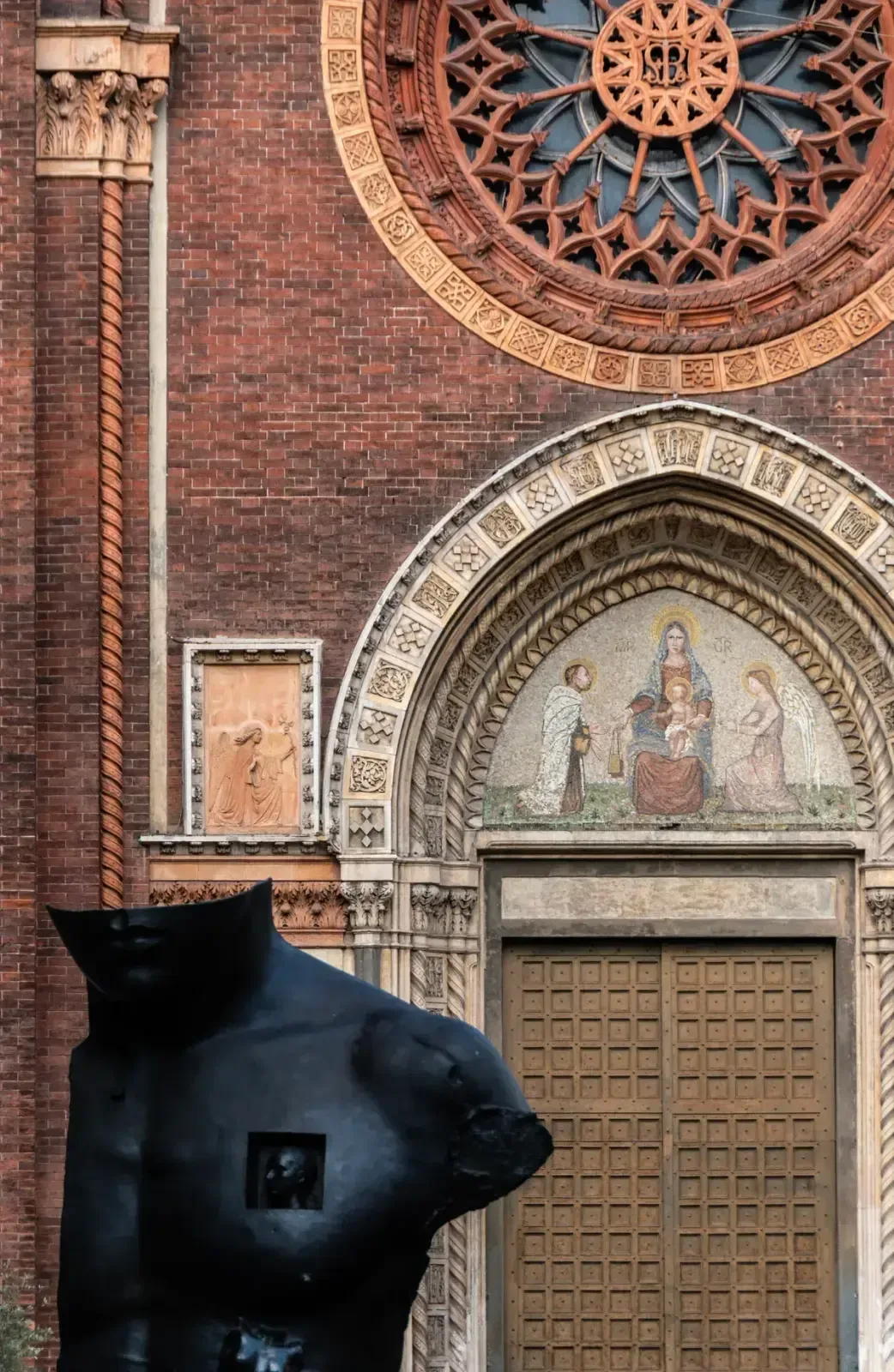
Milan's relationship with Mitoraj extends beyond Piazza del Carmina. The city's galleries, particularly in the Brera district, hosted several of his commercial exhibitions during the 1980s and 1990s, helping establish his Italian collector base at a time when bronze editions of works such as Testa di Ikaro and Perseo were still modestly priced. Today, Italian private collections hold a disproportionate share of his mid-career bronzes, and Milan remains an active secondary market for authenticated pieces.
The Galleria Blu on Via Senato was among the earliest Italian galleries to represent Mitoraj seriously, mounting a dedicated solo exhibition in 1981 that introduced Milanese collectors to his fragmented classical vocabulary before his international profile solidified. Works shown in that period—including early bronze studies of Eros Bendato and smaller Testa di Perseo editions—changed hands privately within the city and rarely surface at auction, making Milan-provenance pieces particularly difficult to trace today.
Milan's Museo della Permanente hosted a significant Mitoraj retrospective in 1998, bringing together over forty bronzes and marble works spanning two decades. The exhibition catalogue, published by Skira with an introduction by Vittorio Sgarbi, remains one of the more rigorously documented references for authenticating mid-career pieces and is actively sought by serious collectors. Copies with original price lists inserted by participating dealers occasionally surface through Milanese antiquarian booksellers.
The Fiera Milano art circuit played a meaningful role in sustaining Mitoraj's market visibility during the 1990s, with several editions of Eros Bendato and Testa di Perseo appearing through secondary dealers at miart, the city's international modern and contemporary art fair. Collectors who acquired bronze works through that channel in the mid-to-late 1990s typically paid between 15,000 and 40,000 euros depending on edition size and patination, figures that now represent a fraction of current secondary market valuations for authenticated mid-career pieces with documented Milan provenance.
The 1992 Arte Fiera Milano presentation of Eros Bendato in its larger 180-centimetre bronze edition marked a turning point in how the Italian market valued Mitoraj's monumental-scale works, with several editions from that showing entering Lombard private collections at prices that now appear remarkably modest against current secondary market valuations. Dealers operating around the Brera district during this period frequently brokered direct studio acquisitions, bypassing formal gallery channels entirely, which complicates provenance documentation for pieces originating from this window. Collectors pursuing Milan-provenance bronzes from the early 1990s should prioritise works accompanied by correspondence with the Pietrasanta foundry confirming casting sequences.
The Castello Sforzesco's civic collections include a small number of Mitoraj drawings acquired through municipal purchase in the early 1990s, representing one of the few instances where a major Italian public institution formally acquired works on paper rather than bronze. These sheets, primarily studies for monumental heads executed in pencil and wash, are held within the Gabinetto dei Disegni and are accessible by appointment, though they are seldom referenced in commercial provenance research. For collectors evaluating works on paper attributed to Mitoraj, the Castello holdings offer a useful benchmark for his draughtsmanship during the period when Testa di Ikaro and related compositions were moving from preliminary study into full bronze edition production.
The Museo Poldi Pezzoli, though not a venue associated with Mitoraj exhibitions, has indirectly shaped how Milanese collectors approach his work: the museum's concentration of fragmented antique sculpture—torsos, masked faces, severed limbs rendered in marble and bronze—provides a visual framework through which serious buyers in the city tend to read his idiom. Dealers operating near Via Manzoni have noted that collectors who frequent the Poldi Pezzoli often arrive with a more calibrated eye for patination and surface quality in Mitoraj's bronzes, asking specifically about foundry marks and the distinction between Fonderia Mariani and later casting sources. Pieces such as Eros Bendato and Centurione in larger editions attract particular scrutiny in the Milan market, where provenance documentation linking a work to the 1981 Galleria Blu period commands a measurable premium over equivalent pieces without that Milanese exhibition history.
The Fondazione Pomodoro, based in Milan's Via Solari complex, periodically references Mitoraj in the context of postwar figurative sculpture when mounting thematic group exhibitions, offering collectors a useful comparative framework for situating his classical fragmentation alongside Italian contemporaries such as Arnaldo Pomodoro and Giò Pomodoro. More directly relevant to the market is the recurring presence of Mitoraj bronzes at Finarte's Milan salerooms, where Testa di Ikaro variants and smaller Eros Bendato editions have appeared with some regularity since the early 2000s. Condition reports from these sales consistently note the distinctive dark patination Mitoraj preferred for works cast at the Fonderia Mariani in Pietrasanta, a detail that helps differentiate authorized lifetime casts from posthumous editions. Collectors acquiring through the Milan secondary market are advised to cross-reference any accompanying documentation against the foundry's cast numbering conventions, as pieces circulating without original certificates have occasionally been misattributed within Italian private sales.
The Brera Academy's influence on Mitoraj's Milanese reception should not be underestimated. Having studied briefly in Kraków before relocating to Paris, Mitoraj found in Milan's academic and curatorial circles a receptive audience already attuned to classical figuration through the legacy of De Chirico and the Novecento movement. The dealer Claudia Gian Ferrari, whose Via Manzoni gallery operated through much of the 1990s, reportedly facilitated several significant private placements of Mitoraj bronzes among Milanese industrial families, transactions that never entered public auction records. Collectors acquiring works during this period often received certificates of authenticity countersigned by the Pietrasanta foundry, typically Fonderia Mariani, which adds a traceable layer of provenance absent from earlier Paris-period pieces. A secondary concentration of Mitoraj works exists in corporate collections along Milan's financial corridor, where Eros Bendato and smaller versions of Testa di Arianna were acquired during the early 2000s as prestige commissions for banking and insurance headquarters. These institutionally held pieces rarely come to market but occasionally surface during corporate restructurings, offering collectors an opportunity to acquire works with unusually complete documented histories.
The Fondazione Mudima, operating from its Via Tadino premises since the late 1980s, documented several Mitoraj loans and deposits from Milanese private collections during the 1990s, providing an institutional paper trail that collectors and authenticators still reference when establishing provenance for unsigned or ambiguously documented bronzes from that decade. Of particular interest to the market are the mid-sized editions of Eros Bendato and Testa di Orfeo that appeared in Mudima-adjacent exhibitions between 1992 and 1997; works with a demonstrable connection to this circuit tend to carry modest premium valuations when resold through specialist dealers in northern Italy. Separately, the Milanese casting foundry Fonderia Artistica Battaglia, which has collaborated with numerous significant sculptors working in Italy, is documented as having produced a limited number of Mitoraj bronze casts during the late 1980s, and pieces bearing Battaglia stamps are occasionally presented to appraisers in the city. Collectors acquiring such works should verify edition numbers and patination consistency against comparable dated examples, since Battaglia-stamped bronzes without accompanying studio certificates require particularly careful scrutiny. The auction house Finarte, historically based in Milan before its operational restructuring, handled several Mitoraj lots between 1995 and 2003, and its sale catalogues from that period—available through the Biblioteca Nazionale Braidense—constitute a useful benchmark for tracking how secondary market valuations for authenticated mid-career pieces evolved during that window.
האם ברשותכם יצירת מיטוראי מאיטליה?
יצירות מיטוראי במילאנו — תרס מונומנטלי בפיאצה דל קרמינה בשכונת ברֶרה ויצירות בתיאטרון לה סקאלה.
Any other Mitoraj work also welcome — any subject, condition, or format.
ראו גם: גרסה אנגלית · מפת אירופה · כל הערים
אודות אוסף זה
אתר זה מתעד את חיפושו של אספן פרטי אחר יצירות מאת איגור מיטוראי (1944–2014) — הפסל הפולני-צרפתי המפורסם בזכות פיגורות קלאסיות שבורות בברונזה ושיש. מיטוראי למד בקרקוב אצל טדאוש קנטור, התאמן בפריז בבית-הספר הלאומי העליון לאמנויות יפות, והקים את הסטודיו הקבוע שלו בפייטרסנטה, טוסקנה, בשנת 1983. יצירותיו מוחזקות באוספים ציבוריים ברחבי אירופה ואמריקה. אם ברשותכם יצירת מיטוראי, אנא צרו קשר.
מעוניינים למכור יצירה של מיטוראי? לעמוד המכירה שלנו →